
|

|

|

|

|

|

|

|
|
In a hurry? Learn in small bites! Sign up for my free, 7-day e-mail mini-course, and I'll dish up the basics in just one week!
|

|
|




|
|
|
 |
 |
|
|
Holding
Effective Meetings Can Be Easier than You Think! I’m sure you’ve experienced those typical “headache” meetings! You know the kind I’m talking about — the ones where the key players are running late, no one knows exactly why the meeting was called, and there’s not a single agenda in sight. Everyone’s sitting around wondering, “Will this last 20 minutes or will we be here all day?” It’s impossible to tell! Then, once the meeting finally gets off the ground, the real pandemonium starts. For instance:
To counteract these frustrating problems, this article reveals four techniques for running great meetings and following up afterward. First, How Big Is the Problem?
Not only do they have the potential to make the participants feel perpetually frustrated and unproductive, they’re also a financial drain. Just in the area of cost, have you ever tried to calculate the expense of holding even a single unproductive meeting? If you multiply the number of people sitting in a room by an average hourly rate, and add the cost of employee benefits (overhead), you’ll see what I mean. And that’s the average cost for a holding a single meeting, not including expenses for any related travel, food, or equipment. You can multiply that figure across the entire company to estimate the cost of meetings held per month and per year. As you can imagine, holding meetings, especially unproductive ones, can be an expensive proposition! How Can You Turn Your Meetings Around? In contrast to the chaotic, unplanned encounters, at well-run meetings, participants collaborate to produce a valuable outcome. They also leave the meeting feeling that their time was really well spent. Making simple changes to the protocols for running meetings can shift the dynamics into a highly effective mode. To achieve excellent results, try the following: 1. Be sure you really need a meeting before scheduling it. Respect your colleagues’ busy schedules.
2. Send out a meeting notice and agenda well in advance. Give your attendees plenty of advance notice — for example, at least a week. Also consider whether any of your invitees are likely to be unavailable on that date. If so, you may want to postpone the meeting or seek alternates. Be sure your meeting notice includes all of the key information: Include the 1) meeting date, 2) starting and ending times, 3) purpose, 4) attendees, 5) location with directions or access instructions, and 6) the proposed agenda. That way, everyone will know exactly what to expect, what to do, what their time commitment is, and what’s in it for them! 3. Conduct the meeting using good facilitation techniques. Here are some of the most effective techniques professional facilitators use:
4. Follow up afterward with summaries and action items. After you’ve completed all of that hard work, you can avoid having everyone’s ideas and decisions simply melt away because no one sent out a good summary or bothered to track the agreed-upon assignments. A summary doesn’t have to be fancy or very detailed to be effective, but it should contain enough substance to inform the people who weren’t there, for example. The summary should list: 1) each topic, 2) the key
points of each topic discussion, 3) all decisions made, and 4) action
items and due dates. At the end, it may include the next meeting’s
5) proposed agenda, 6) date and time, and 7) location, if known. With a little fine-tuning, you can convert your meetings from profit stealers into profit boosters. The process will transform the quality of group collaborations and breathe new life into your morale and productivity! To download the Meeting Checklist, click here. ~~~~~~~~~~~ Adele Sommers, Ph.D. is author of “Straight Talk
on Boosting Business Performance: 12 Ways to Profit from Hidden
Potential.” To learn more about her book and sign up for more
free tips like these, visit her site at www.LearnShareProsper.com This article may be distributed freely on your Web
site, as long as this entire article, including the links and full
“About the Author” section, are unchanged. Please send
a copy of, or link to, your “reprint” to Adele@LearnShareProsper.com. Copyright 2005 Business Performance Inc., Adele Sommers, All Rights Reserved.
807 words |
||
 |
 |
 What
are the consequences of holding ineffective meetings? Meetings
held for the wrong reasons, that don’t involve the right participants,
or that don’t use a disciplined meeting process can waste the
time, resources, and money of the business.
What
are the consequences of holding ineffective meetings? Meetings
held for the wrong reasons, that don’t involve the right participants,
or that don’t use a disciplined meeting process can waste the
time, resources, and money of the business.  Don’t
set up a meeting unless:
Don’t
set up a meeting unless:
|
|

|
|

|
Receive “just in time” tips for tuning up your business performance, sent to your in-box every 2 weeks! Yes! Send FREE Boosting Business Performance advice!
|
 |
 |
|
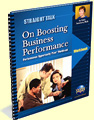
Explore the award-winning “Straight
Talk” series by Adele Sommers, Ph.D.
|


Home | Start
Now! | Free Articles | Audio Classes
| Products & Tools | Recommendations
| Mentoring Program | About
Us | Site Index | Privacy
Policy | Terms & Conditions of Use
| Newsletter Sign-up | Newsletter Index | Free 7-Day Minicourse | Free Report |