|
What's on Your Meeting Agenda?
by Adele Sommers, Ph.D.
Conducting great meetings depends on several activities that occur before, during, and after each event. To help you establish the conditions for success and attain the very best results, this article lists essential tips on using meeting notices, agendas, and summaries.
Use Meeting Notices to Alert Your Attendees
Meeting notices act as an "early warning system" for your participants. You should use them regularly and give recipients plenty of lead time -- for example, at least a week. Avoid surprising people with a last-minute summons that disrupts their entire day. Below are some useful guidelines:

|
Be sure your meeting notice includes all key information:
1) Meeting date
2) Starting and ending times
3) Purpose and objectives
4) List of participants
5) Location with directions or access instructions
6) Proposed agenda
That way, everyone will know exactly what to expect, what to do, what their time commitment is, and what's in it for them! Request that people notify you well in advance if they will be unable to attend. |
|
If using a Web or telephone conferencing system, be sure to provide access instructions in your meeting notice, and any rules or protocols people should observe when logging or calling in to the conference.
For example, if needed, indicate the meeting time by time zone (use timeanddate.com/worldclock/converter.html for conversions), the call in number, and access code.
Explain remote meeting protocols, such as announcing oneself initially, and stating one’s name before making a comment. |
|
Send out a reminder the day before the meeting. |
Do All Meetings Need an Agenda?
 You may be wondering whether an agenda is absolutely necessary. The answer is, it depends! You may be wondering whether an agenda is absolutely necessary. The answer is, it depends!
An agenda provides structure; however:
- the fewer the people involved
- the fewer the topics you'll have to discuss
- the longer the time you have available, and
- the lower your expectations are...
...the less you'll need structure to get something done. If, say, you're just going out for a long lunch with a few people to toss around some ideas on a single topic, and you have no real expectations for what you need to accomplish, then you probably don't need an agenda.
Conversely, if you:
- involve more people
- to discuss more subjects
- in a compressed time frame
- with some very specific expectations for the outcome...
...then an agenda is an indispensable tool to help people focus on achieving the desired results. Agendas not only prepare attendees for what to expect, they also keep the meeting focused, and make the summarizing aspects much easier.
A sample meeting notice and agenda appear below:
Meeting Notice & Agenda
Date: Thursday, March 15, 2007
Time: 9:00 a.m. to 2:00 p.m. PST (a working lunch will be provided). For remote attendees, start at 10:00 MST, 11:00 CST, Noon EST, 5:00 p.m. UTC.
Purpose & Objectives: The Human Resources Department requests your participation to explore the personnel development needs of the company's centers of excellence in 2007-08. Based on the findings from this session, we will schedule follow-up events to fine-tune our planning process.
Requested Participants: Representatives from the following centers are asked to attend (or participate remotely via live Web seminar conferencing):
* Marketing/Sales
* Customer Service
* Product Development
* Quality Assurance
|
* Order Fulfillment
* Publications & Media Design
* Information Technology
* Training & Development
|
Location:
The Cranberry Building, 246 South St., Room B18. Please park in the Visitor area behind the building. You will receive parking validations at the meeting. Overnight accommodations and shuttle transportation will be arranged for participants flying in from other locations.
Remote Access Instructions:
For those participating via Web seminar, use the standard company Web seminar link and access meeting #123456. You can listen using voice over IP (VoIP), or call the bridge line at +01-555-555-1212 and use access code 54545#. You will see all electronic slide presentations and can interact with the on-site meeting attendees through a Web seminar facilitator.
Proposed Agenda:
- Overview and agenda review by the VP of Operations
(30 min.)
- Strategic Planning presentation (30 min.)
- Brainstorming breakout sessions, with facilitators
(90 min.)
- Working lunch and reporting back to the main group
(90 min.)
- Discussion, wrap up, and a review of the next steps
(60 min.)
Handouts will be available on the server 48 hours prior to the meeting. The meeting summary and recorded Web seminar will be available 48 hours afterward.
RSVP Requested: Please reply no later than Feb. 15, 2007 with the names and contact information for the representatives from your group who will be attending, either on-site or remotely. |
So, What about the Meeting Summary?
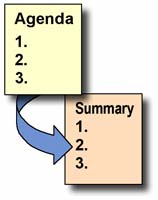
The agenda and summary are the two anchor points for the whole meeting process. They represent the beginning (here’s what we aim to do) and the end (here’s what we did do).
To create a summary, you simply go down the agenda topics, record the key points, decisions, and action items, and voila! You have a summary. It’s really not that hard, but it does take a little time and discipline.
The summary helps ensure that the valuable time people spend in meetings will not be wasted, as the recorded ideas can proceed to drive future actions and decisions.
A sample meeting summary, with action item reminders, appears below:
Meeting Summary with Action Items
This is a summary of the Strategic Planning & Brainstorming meeting held on March 15, 2007. The Human Resources Dept. called the meeting to explore the personnel development needs of the company's centers of excellence in 2007-08. The following representatives participated...
Based on the findings from this session, we will schedule at least two follow-up events to fine-tune our planning process.
Summary:
- The meeting began with the overview and agenda review by the VP of Operations, followed by the Strategic Planning presentation given by the executive planning committee.
- The brainstorming breakout sessions surfaced a total of 47 major objectives from the centers of excellence, as follows:
.
.
.
- During the wrap-up and review session, 15 key points emerged that Human Resources has agreed to investigate before the next scheduled planning session, as follows:
.
.
.
- Next Meeting Date: The next meeting will occur on the morning of May 17, 2007 from 9:00-12:00 PST. Further information about that event is forthcoming.
Action Items:
| Issue |
Priority |
Description |
Actionee |
Date Open |
Due Date |
1. |
High |
Explore options for... |
John R. |
3/15/07 |
5/17/07 |
2. |
Medium |
Answer concern about... |
Louise C. |
3/15/07 |
3/29/07 |
3. |
High |
Meet individually with... |
Martin D. |
3/15/07 |
5/17/07 |
|
In conclusion, meeting notices, agendas, and summaries encourage participants to contribute in an enthusiastic and meaningful way. They provide a robust structure that can compensate for any other aspects of meetings that are less than perfect. Copyright 2007 Adele Sommers
=-=-=-=-=-=-=-=-=-=-=-=-=-=-=-=-=-=
For free meeting tools, see: https://learnshareprosper.com/products.html#meetings.
=-=-=-=-=-=-=-=-=-=-=-=-=-=-=-=-=-=
Adele Sommers, Ph.D. is author of “Straight Talk
on Boosting Business Performance: 12 Ways to Profit from Hidden
Potential.” To learn more about her book and sign up for more
free tips like these, visit her site at www.LearnShareProsper.com
This article may be distributed freely on your Web
site, as long as this entire article, including the links and full “About the Author” section, are unchanged. Please send
a copy of, or link to, your “reprint” to Adele@LearnShareProsper.com.
Copyright 2007 Business Performance Inc., Adele Sommers, All Rights Reserved.

995 words
Return to the Free Articles
index |
|