|
|
January 8, 2009
Volume 5, Issue 1
"How-to" tips and advice on increasing
business prosperity, published every other
Thursday.
To change subscription options, please
see the end of this message.
Sign
me up for this newsletter! |
|
New Year's Greetings!
-- Feature Article: How Engaging Your Workforce Can Boost Your Bottom Line (Part 1)
-- Note from the Author: It's Time to Aim Beyond Job Satisfaction
-- Special Message: Are We There Yet?
-- The Author Recommends: Joining the "Leadership Pulse" Project
Please add "Adele@LearnShareProsper.com"
to your whitelist or address book in your e-mail program,
so that you have no trouble receiving future issues.
You subscribed at LearnShareProsper.com,
and you're welcome to forward this newsletter to your
colleagues; please just keep the entire message intact.
If you wish to discontinue your subscription, please
use the links at the bottom.
|
|
 |
|
It's Time to Aim Beyond Job Satisfaction
 My last newsletter delved briefly into the critical topic of "employee engagement," and gave a short, high-level overview of the powerful and directly measurable effects it can have on the vitality of a public or private sector organization. My last newsletter delved briefly into the critical topic of "employee engagement," and gave a short, high-level overview of the powerful and directly measurable effects it can have on the vitality of a public or private sector organization.
Because of the strong correlations found to exist between employee engagement and a company's financial viability, numerous research firms are studying intently how to measure and manage the factors that contribute most to increases or decreases in productivity and profitability.
BlessingWhite, Inc. defines engaged employees as those who are committed, passionate, and also harbor "a line-of-sight on their own future and on the organization's missions and goals ... using their talents and discretionary effort to make a difference in their employer's quest for sustainable business success." At this point, you may be wondering: Isn't that the same as job satisfaction?
It turns out the answer is no; engagement extends far beyond satisfaction. That's why today's issue explores employee engagement in greater detail and from various points of view. It's such a meaty subject that researching and reporting on the latest trends is a lot like taking a bite of an enormous sandwich and then finding that one almost cannot stop chewing!
For these reasons, I hope you enjoy today's features, including "How Engaging Your Workforce Can Boost Your Bottom Line (Part 1)." And please join the conversation by leaving your comments on my blog!
Here's to your business prosperity,

Adele Sommers, author of the "Straight
Talk on Boosting Business Performance" success
program
P.S. If you missed any previous issue, visit
the newsletter index!
|
|
 |
Are We There Yet?
Whether you're in a large organization or a small business startup, a few elusive questions you may be pondering are, "Are we there yet? Are our people happy and committed enough to stay, learn, and grow with us, while contributing 110% of their talents to our success? Are we creating conditions that will help people feel valued while enabling them to contribute remarkably and directly to our mission and goals?"
 What would the conditions and results look like when managers and staff members mutually engage in a focused, concerted, and deeply rewarding effort to produce world-class products and services? What would the conditions and results look like when managers and staff members mutually engage in a focused, concerted, and deeply rewarding effort to produce world-class products and services?
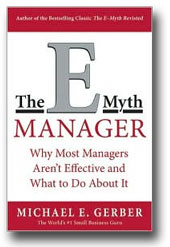
Michael E. Gerber offers timeless insights into this ongoing journey in "The E-Myth Manager: Why Most Managers Aren't Effective and What to Do About It." He proposes a system of helping organizations innovate, quantify, and orchestrate the results they wish to see:
- Recognize that the organization as a whole carries the main responsibility for identifying the best way to solve problems and achieve desired results. As an organization, aim for "discovering the very best methods, processes, and systems for producing results that will make everyone in the organization, and everyone depending upon it, extremely successful." (p. 130)
- Provide all personnel with a way to "set their own benchmarks, personal and organizational, and then help them in every way you can" to realize those benchmarks. Give people access to up-to-date information on results and ask them to analyze and share daily what they are learning about improving their individual and group performances. (p. 132-33)
- Encourage every person in the organization to think like an entrepreneur and operate like a personal revenue center. Provide insight into organizational cashflows and involve everyone in the subject of capital: "how it works, where it goes, how much is left, how it's spent, and how much everyone gets at the end of the day." (p. 144)
- Set unusual (but not unreasonable) expectations, such as asking all staff members to tell the truth as they see it regarding the organization, despite how difficult it may be because of prior upbringing and conditioning. Request their commitment to being fully present each day and to nurturing a desire to learn. Ask everyone to continually discover what works, what doesn't work, and why. If something isn't working, aim to discover increasingly better ways of doing it. (p. 202-04)
These snapshots of organizational culture suggest how to engage employees in the fundamental workings and the success of the enterprise. They imply a need for organizational transparency; for leaders modeling the behaviors and roles they want their personnel to emulate; for shared learning, continuous improvement, observing cause and effect, and personal responsibility; and measuring and monitoring results.
Read on for more perspectives on engaging employees...
|
|
 |
How Engaging Your Workforce
Can Boost Your Bottom Line (Part 1)
by Adele Sommers

Throughout this decade, "employee engagement" initiatives have been gathering steam, emerging as large-scale, Human Resources-sponsored campaigns in many organizations and governments. The stakes are enormous because of the proven correlation between high levels of employee engagement and superior productivity and profitability.
This article, the first in a series, explores what engagement is, why it's so important to your bottom line, various techniques for measuring it, and related considerations.
What Exactly Is Engagement?
A 2007 literature review commissioned by Scottish Executive Social Research, "Employee Engagement in the Public Sector," summarizes the characteristics of an engaged workforce drawn from many respected sources. The term "engagement" typically denotes a focus on employee motivation, satisfaction, commitment, finding meaning at work, pride in working for and advocacy of the organization, and feeling connected to and wanting to contribute to the organization's overall strategy and objectives. A further recurring theme is a willingness to exert extra discretionary effort to go above and beyond what is expected in one's core role.
 According to The Gallup Organization's recent book on this topic, "12: The Elements of Great Managing" by Rodd Wagner and James K. Harter, engagement requires great managers who can inspire top employee achievement, as measured in twelve key dimensions. According to The Gallup Organization's recent book on this topic, "12: The Elements of Great Managing" by Rodd Wagner and James K. Harter, engagement requires great managers who can inspire top employee achievement, as measured in twelve key dimensions.
Employee engagement thus involves a process by which engaged managers "generate enthusiasm, unite disparate personalities to focus on a common mission, and drive teams to achieve ever-higher goals."
Most importantly, engagement occurs at the local level, under specific managers. One could infer that employees might feel satisfied with an organization overall, but the phenomenon of engagement typically occurs in particular work groups where great managers have direct influence.
Why Is Engagement Receiving So Much Attention?
Results of recent studies include the following, which highlight the urgency of coming to grips with the phenomena involved:
- A BlessingWhite, Inc. 2008 global study, "State of Employee Engagement," reports that 29% of employees are fully engaged and 19% are disengaged. (Note that these kinds of figures can vary significantly from business unit to business unit, industry to industry, country to country, and study to study.)
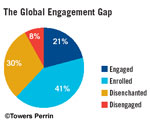 A Towers Perrin 2008 "Global Workforce Study," in contrast, indicates that 21% of employees can be considered fully "engaged" and 41% are "enrolled" (otherwise good employees who lack an emotional connection to the organization). The rest are either "disenchanted" or "disengaged." A Towers Perrin 2008 "Global Workforce Study," in contrast, indicates that 21% of employees can be considered fully "engaged" and 41% are "enrolled" (otherwise good employees who lack an emotional connection to the organization). The rest are either "disenchanted" or "disengaged."
Further, the high-engagement firms enjoyed a 28% EPS (earnings-per-share) growth rate, compared to an 11.2% decline for firms with low engagement.
- The Gallup Organization states in "The High Cost of Disengaged Employees" that actively disengaged employees are costing U.S. companies as much as $350 billion annually in lost productivity.
- The British government reported in a recent news update that "only around 12% of the UK workforce can be considered as highly engaged," which "shows that there is potential for huge gains for the economy if we can improve in this area."
How Are Organizations Measuring Employee Engagement?
 Many organizations are surveying employees annually, or more frequently, to monitor employee engagement levels. For example: Many organizations are surveying employees annually, or more frequently, to monitor employee engagement levels. For example:
- Gallup's 12-question survey for measuring employee engagement was originally published in its 1999 bestseller, "First, Break All the Rules" (see more survey background information here).
According to the more recent sequel, "12: The Elements of Great Managing," Gallup has since accumulated over 10 million sets of responses to this survey from 114 countries. From this huge database, it derived a highly predictive model of organizational health. That's because each time Gallup conducts a survey within an organization, it also collects a plethora of related operational data to help assess how the organization's levels of engagement are affecting its bottom line.
- The Scottish Executive Social Research report, "Employee Engagement in the Public Sector," lists survey items from a variety of industry questionnaires. The questionnaires measure employees' feelings and opinions regarding their loyalty, pride, accomplishments, contributions to the organization, recognition received, training and development options, desire to put in extra effort, the degree of encouragement and inspiration they receive from management, camaraderie with peers, and much more.
- Towers Perrin's 2003 report, "Working Today: Understanding What Drives Employee Engagement," includes the nine survey items it had used to assess "both emotional and rational factors relating to work and the overall work experience. The emotional factors tie to people's personal satisfaction and the sense of inspiration and affirmation they get from their work and from being part of their organization."
How Do Workplace Obstacles Affect Employee Engagement?
Are the surveys above asking all of the relevant questions? One might wonder, for instance, whether they are focusing sufficiently on the broader range of barriers to success -- an organization's "burning hassles" -- and their impacts on engagement.
Theresa M. Welbourne, Ph.D., the founder, President and CEO of eePulse, Inc. and Associate Professor of Organization Behavior and Human Resource Management at the University of Michigan Business School, researches employee engagement. She offers these observations (excerpted with permission from "Employee Engagement: Doing It vs. Measuring It"; emphasis mine):
 "Engagement is about getting rid of things that block productivity. We think that we can magically motivate people, but what we primarily do in business is create lots of ways to demotivate people. We bring people to work, ask them to do something, then put lots of obstacles in the way of their being able to succeed. We excel at demotivation -- not motivation. Creating an engaged workforce means getting barriers out of the way for your employees to be effective. . . . These things can be "lumped" into categories, but they differ from company to company, department to department, and employee to employee. "Engagement is about getting rid of things that block productivity. We think that we can magically motivate people, but what we primarily do in business is create lots of ways to demotivate people. We bring people to work, ask them to do something, then put lots of obstacles in the way of their being able to succeed. We excel at demotivation -- not motivation. Creating an engaged workforce means getting barriers out of the way for your employees to be effective. . . . These things can be "lumped" into categories, but they differ from company to company, department to department, and employee to employee.
"These productivity blockers and demotivators are not taught in a basic introduction to management book. They are not going to disappear with the purchase of some new technology or from hiring the latest management guru. Engagement will happen when each individual manager learns what's getting in the way of his/her employees' performance, and each manager chooses to take action."
In summary, to increase employee engagement, many organizations are:
- Inviting their staff to discuss the meaning of these trends.
- Creating their own employee engagement surveys (or hiring a research firm).
- Collecting baseline data on key operational metrics (absenteeism, turnover, accident rates, defect rates, profitability, customer satisfaction, and so forth).
- Administering the employee engagement surveys and reviewing the findings, including any productivity barriers reported, with employees and managers.
- Developing action plans to make improvements.
- Repeating the surveys periodically, and comparing changes in engagement levels with changes in operational results.
Part 2 of this series will explore the relationship between employee and customer engagement, which has an even more dramatic effect on profitability.
Copyright 2008 Adele Sommers
|
|
 |
|
Joining the "Leadership Pulse" Project
Leadership Pulse is a unique, no-cost way to interact with real-time benchmarking data for your management team derived from the first and only real-time leadership benchmarking and learning project. As a member of Leadership Pulse, you can:
-
 Track validated and predictive human capital metrics (energy, engagement, confidence, and more) Track validated and predictive human capital metrics (energy, engagement, confidence, and more)
- Learn from your peers
- Engage in robust dialogue with thought leaders about the data
- Receive instant personal benchmarking (on-line report comparing your scores vs. your industry and overall trends)
- Have first access to key insights (research reports with deep insights and recommended actions)
- Attend Webinars with industry experts (learn from the merging of data and case studies)
- Participate in live case studies (share your expertise)
- Join the team pulse (add up to 100 members of your team)
|
|
 |
|
Adele Sommers, Ph.D. is the author of "Straight
Talk on Boosting Business Performance" -- an award-winning
Special Report and Workbook program.
If you liked today's issue, you'll love this down-to-earth
overview of how 12 potent business-boosting strategies
can reenergize the morale and productivity of your enterprise,
tame unruly projects, and attract loyal, satisfied customers.
It's accompanied by a step-by-step workbook designed
to help you easily create your own success action plan.
Browse the table of contents and reader reviews on the
description page.
Adele also offers no-cost articles and resources to
help small businesses and large organizations accelerate
productivity and increase profitability. Learn more
at LearnShareProsper.com.
LearnShareProsper.com/Business Performance_Inc.,
7343 El Camino Real, Suite 125, Atascadero, CA 93422,
USA. For information and Customer Service, call +1-805-462-2187,
or e-mail Info@LearnShareProsper.com. |
|
| |
|
|
| |
|
©2008
Business Performance_Inc., Adele Sommers, All rights
reserved. www.LearnShareProsper.com
Your feedback is always appreciated!
Write to us at info@LearnShareProsper.com.
We respect your privacy and do not give out or sell
subscriber names or e-mail addresses.
Please use the links below to take
yourself off our list or change your e-mail address.
|
|
|