How "Engaged" Employees Can Turbocharge the Bottom Line (Part 2)
by Adele Sommers
Want to thrill your customers and turn them into raving fans? Researchers at The Gallup Organization have long studied the powerful relationship between loyal, passionate, and deeply committed customers and a company's bottom line. What makes these customers so special? Gallup found that "highly satisfied" customers deliver 23% more profitability, revenue, and relationship growth than "satisfied" or "dissatisfied" customers do.
In Part 1 of this series, we examined employee engagement. In Part 2, below, we will delve deeper into the crucial interaction between employee engagement and customer engagement.
Why? Gallup has found that encounters between engaged employees and engaged customers contribute far more to a company's financial success than either factor alone. To test Gallup's findings, ten companies used Gallup's recommendations to outperform their largest peers by 26% in gross margin and 85% in sales_growth in a single year.
The Need to Eliminate Variability in Customer Experiences

Have you ever heard this familiar children's saying? "For want of a nail, a shoe was lost; for want of a shoe, a horse was lost; for want of a horse, a battle was lost; for want of a battle, a kingdom was lost."
So states an underlying philosophy and related economic model that measures the losses to society due to poor, unpredictable product and service quality. The farther the products or services stray from perfection, the greater the negative impacts on society. Besides inconveniencing and aggravating customers and those around them, those negative impacts also can ruin a company's reputation and destroy its ability to stay in business.
Solving this problem involves finding ways to reduce and prevent variability in products and services, and thereby producing consistently high quality. For example:
- For products, minimizing variation means ensuring that every article produced conforms as tightly as possible to the ideal, as close to perfection as possible. To address this critical need in the manufacturing arena, quality initiatives such as Six Sigma have helped companies attain extremely low reject rates ("zero defects," in essence) by eliminating variability in systems and processes.
 For services, minimizing variation means competently satisfying all advertised claims, and providing excellent customer care each and every single time a customer interacts directly with an organization's support hotline or other human-based services. Even one disappointing experience can ruin a customer's trust and confidence and minimize his or her loyalty to the company. For services, minimizing variation means competently satisfying all advertised claims, and providing excellent customer care each and every single time a customer interacts directly with an organization's support hotline or other human-based services. Even one disappointing experience can ruin a customer's trust and confidence and minimize his or her loyalty to the company.
Six Sigma paved the road to excellence in manufacturing, but what exactly is the best way to provide consistently satisfying service experiences? Gallup wanted to find out...
Why Human Interactions Are So Tricky
Gallup discovered that as well as it works on the factory floor, Six Sigma doesn't transfer easily to human-based services. In various publications, such as the two below, Gallup reveals fascinating research and findings about why this is so:
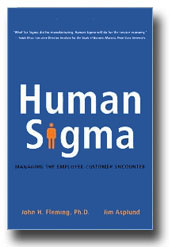 A 2005 Harvard Business Review article, "Manage Your Human Sigma," by John H. Fleming, Curt Coffman, and James K. Harter. A 2005 Harvard Business Review article, "Manage Your Human Sigma," by John H. Fleming, Curt Coffman, and James K. Harter.
The authors explain that when companies attempt to apply Six Sigma principles to human services, they typically strive for consistency by scripting out and training people on the exact statements and steps everyone should use in every situation.
Despite the seeming logic of this approach, employees are much too unique in the way they think, feel, and communicate. People make mistakes; they forget, lose, or misconstrue information; they call in sick and have occasional bad days. People also have unique talents and problem-solving ideas. Therefore, a Six Sigma, zero-defects approach that involves scripting all employee behaviors cannot remove all human variation, nor can it reliably satisfy customers.
Some companies try to solve the "human problem" by completely removing the employees from the customer service equation. Instead, they substitute software, Web servers, and various self-serve options to keep employees out of the picture.
Although it's certainly logical to streamline complex, error-prone business processes, is eliminating humans -- and their idiosyncrasies, uniqueness, and strengths -- the very best way to run a service organization? Gallup discovered otherwise...
Another Way of Viewing Employee-Customer Interactions
To reveal the answers, Gallup researchers conducted studies over many years and analyzed data on hundreds of companies and millions of customers and employees. They gained many eye-opening insights, a few of which appear below.
 One critical finding pertains to meeting customer expectations. When we think about satisfying customers, are we referring to rational or emotional satisfaction? One critical finding pertains to meeting customer expectations. When we think about satisfying customers, are we referring to rational or emotional satisfaction?
- Rational satisfaction occurs from meeting the customer's functional needs or specifications (what I call "quality in fact").
- Emotional satisfaction results when a customer experiences consistently helpful encounters with a company's employees, which ultimately creates a strong, personal tie to the business (what I call "quality in perception"). These bonds involve four levels of increasing attachment: confidence, integrity, pride, and passion, according to Gallup.
These emotional aspects are so strong that they carry extraordinary weight in customers' experiences -- "feelings are facts," explains Gallup. The stronger the relationships they develop, the greater their levels of customer engagement.
Engaged customers have the greatest desire to continue doing more business -- in greater volume, with more transactions, and over a longer time than other types of customers. In one study, Gallup found that the most "emotionally satisfied" (highly engaged) customers spent 184% more than (almost twice as much as) either the "rationally satisfied" or "dissatisfied" customers. This shows why engaging customers emotionally is so valuable!
Bottom Line: Engaging Customers Also Requires Engaged Employees
What engages customers the most, and how do we achieve it? Gallup found that:
- It's not simply rational, automated transactions that excite customers, as efficient and accurate as those transactions might be. (The rational aspects are necessary, but not sufficient by themselves, to satisfy customers.) Rather, it's the employees who create the relationships that customers crave. In fact, the long-term success of any type of service -- from fashion to high tech -- seems to depend on developing strong personal relationships.
- To help employees successfully engage customers, companies must allow them to express their uniqueness and creativity while satisfying the customers' needs, rather than trying to script every single aspect of their interactions.
 Employee-customer encounters are highly localized and can vary greatly from location to location within the same organization. Because of this variability, companies must measure and manage these encounters locally. Employee-customer encounters are highly localized and can vary greatly from location to location within the same organization. Because of this variability, companies must measure and manage these encounters locally.
- Managing customers and personnel typically occurs in different parts of an enterprise. To optimize their employee-customer encounters, companies might need to reorganize to shift both groups under the same management.
- Gallup's single HumanSigma metric quantifies and summarizes the value of optimizing employee-customer contacts within each business unit or group. The optimized business units enjoy overall improvement and growth at 3.4 times the rate of non-optimized units.
In conclusion, Gallup's research demonstrates that carefully managed interactions between engaged customers and engaged employees are among the most effective drivers and predictors of profitability. These interactions depend on fostering a work environment where employees have the latitude to creatively serve customer needs while building satisfying, long-lasting, emotional relationships.
Copyright 2011 Adele Sommers
|





 As the New Year gets into swing, many organizations are looking for every possible advantage to counteract the current economic uncertainty. If your group is one of them, then I have terrific news for you -- there is much more valuable information yet to glean from the wealth of recent employee engagement research, the subject of my

 The customer thinks, "Why aren't they open to my ideas? Don't they believe my opinions have value? My complaint is valid, my suggestions are good, and if they don't want to listen to them, I'll take my business elsewhere!"