What's Holding You Back?
Tips on Managing Your Biggest Constraints
by Adele Sommers
Are you struggling with getting things done, but nothing you or your company does seems to increase your overall level of output? The problem may be caused by constraints in your workflow, or even limitations in your thinking processes.
This article explores ways to identify and manage constraints in manufacturing, projects, and other business and personal situations. To optimize results, start by avoiding a false sense of productivity in your organization. It really doesn't matter how much each individual department or work group produces (these are called "local efficiencies"); it's what your entire organization puts out that counts.
Where's the Bottleneck? Introducing the Theory of Constraints
Dr. Eli Goldratt introduced the Theory of Constraints (TOC) more than 20 years ago to provide a powerful new way of thinking about ineffective workflow and accounting practices in manufacturing firms. TOC applications have since expanded into project management, software development, marketing, problem solving, interpersonal communications, and more.
In its simplest mode, TOC entails a set of principles for identifying and managing (or ideally, eliminating) limitations and bottlenecks in any business situation. Handling them effectively can vastly increase your potential for success.
 Examples of bottlenecks in manufacturing include processes or pieces of equipment that can't produce more than a certain level of output because of their own volume or speed limitations. Examples of bottlenecks in manufacturing include processes or pieces of equipment that can't produce more than a certain level of output because of their own volume or speed limitations.
Superhuman effort can't shovel work through the system any faster than the constraints will allow, unless people bypass, work around, or ease each bottleneck's limitations. For example:
- On the factory floor, a constraint in an assembly process appears wherever piles of material accumulate problematically at any workstation. If that station cannot process the material quickly enough to keep pace with the incoming work, it acts as the "pacing factor" for the entire workflow up to that point. The traditional expeditor's job is usually to bypass the problem by rushing hot work orders around out of sequence. Soon, everything becomes "high priority"!
- In a food preparation facility, constraints might include the oven capacity or the processing equipment. If one limitation is the oven size, for example, no matter how fast the choppers chop or the sauce makers stir, nothing will allow more than a certain number of lasagna dishes to be cooked at one time. And hiring more people to make sauces or noodles will only add to the backlog if the oven capacity doesn't increase accordingly!
Until someone identifies and resolves these constraints, the whole system remains at their mercy. Frantically expediting work around the bottlenecks makes accurate scheduling impossible. It also produces a chaotic and unpredictable stream of output. Realize that these are system problems that management must resolve; they're usually outside the control of individual workers.
The good news is that you can optimize the workflow to make the constraints the stars of the show. In so doing, you can better schedule -- and therefore, predict -- the speed and output of the workflow. For example, you could consider whether to:
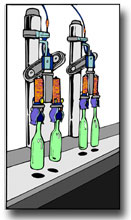 Increase the capacity of the bottleneck by replacing or retrofitting the slower equipment with faster, more efficient, or larger-sized models. Increase the capacity of the bottleneck by replacing or retrofitting the slower equipment with faster, more efficient, or larger-sized models.
- Buy, borrow, or rent similar, low-capacity equipment and use it in tandem with the existing equipment, which will increase the throughput.
- Schedule additional shifts to run the slower, existing equipment, thereby reducing the backlog and keeping pace with the incoming material.
- Modify the product designs, streamline processes, and/or resequence the workflow to either remove or better utilize the bottleneck.
Battling Constraints in Projects
Sometimes, despite our best intentions, we bite off more than we can chew -- or find that a mundane flow of project activities is suddenly backlogged and threatens to derail our ability to complete the project on time.
If your progress reports show too much work to accomplish in the time available, try to determine where the bottlenecks exist in the planned activity sequence. Whether you discover the blockade through simple observation or via sophisticated computer modeling, you can brainstorm a variety of ways to relieve it.
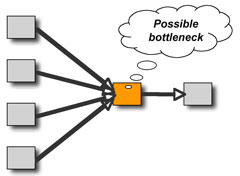 For instance, you could focus all attention on supplying resources to the bottleneck. You could possibly accelerate the flow of work by relieving some performers of the time-consuming tasks. Consider whether some jobs that generalists perform could occur in "assembly line mode," where specialists step in to handle certain things. For instance, you could focus all attention on supplying resources to the bottleneck. You could possibly accelerate the flow of work by relieving some performers of the time-consuming tasks. Consider whether some jobs that generalists perform could occur in "assembly line mode," where specialists step in to handle certain things.
For example, let's say that highly skilled information designers would normally do a large amount of editing and formatting as part of their roles. Yet they easily become bogged down in those painstaking tasks.
So you might investigate whether using specialized editors and formatters could remove that burden from the generalists' shoulders, leaving them to concentrate on the remainder of what they do best. Shifting the workload around in this way could reduce pressure, speed up the work, and potentially save the day for the project!
Constraints in Other Business and Personal Situations
You may have felt the effects of subtle and not-so-subtle constraints that keep you from accomplishing all that is possible in your business and professional life. This is yet another dimension of TOC.
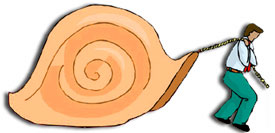 Have you ever wondered whether any drag you've been experiencing occurs from insufficient knowledge, smarts, energy, talent, commitment, or resolve? These arenas represent aspects of your potential, but aren't necessarily what's holding you back. Have you ever wondered whether any drag you've been experiencing occurs from insufficient knowledge, smarts, energy, talent, commitment, or resolve? These arenas represent aspects of your potential, but aren't necessarily what's holding you back.
For example, you may have been pondering whether to attend more classes, put in more time, improve your skill set, or otherwise struggle even more valiantly than you already do. If so, you'll be glad to know that the answers may be simpler and more precise than the range of possibilities you've been considering.
According to business advisor Rich Schefren, our real successes do not relate as much to demonstrating our potential as they do to removing our constraints. Focusing on and removing our constraints (by asking, "What's holding me back?") often is more effective than perfecting our potential. Our constraints could be rational, procedural, or self-imposed, such as:
- Linear thinking that prevents us from seeing our organizations as complete systems (rational)
- Bottlenecks in our selling processes that prevent prospective customers from completing purchasing transactions (procedural)
- A fear of making mistakes, even though experimentation is what helps us learn what works and what doesn't (self-imposed)
In conclusion, identifying and managing business and personal constraints could offer the "silver bullets" your organization needs to excel. In so doing, you can stop swimming upstream, break through previous barriers, and enjoy increasing success.
©2011 Adele Sommers
|








 "
" "
"