|
|
March 8, 2007
Volume 3, Issue 5
"How-to" tips and advice on increasing
business prosperity, published every other
Thursday.
To change subscription options, please
see the end of this message.
Sign
me up for this newsletter! |
|
Greetings!
- Feature Article: 7 Tips for Developing Systems for Success
- Note from the Author: It's Time to Get Organized!
- Special Message: A Fascinating Source of Business Diagrams
Please add "Adele@LearnShareProsper.com"
to your whitelist or address book in your e-mail program,
so that you have no trouble receiving future issues.
You subscribed at LearnShareProsper.com,
and you're welcome to forward this newsletter to your
colleagues; please just keep the entire message intact.
If you wish to discontinue your subscription, please
use the links at the bottom.
|
|
 |
|
It's Time to Get Organized!
This last few weeks, the subject of systematizing business operations has cropped up several times in conversations with people in my consulting circle who are working diligently to grow their businesses. Why is this so important?
 Some of my clients and colleagues are in a start-up mode, some are preparing to ramp up to the next level, and others have recently expanded or are getting ready to explode with new business. All of these situations require ensuring that systems exist to support these expansions. Some of my clients and colleagues are in a start-up mode, some are preparing to ramp up to the next level, and others have recently expanded or are getting ready to explode with new business. All of these situations require ensuring that systems exist to support these expansions.
Yet the perennial dilemma with business growth is how to make the extra time to get organized by documenting processes and procedures. It seems that every waking minute goes toward just getting the job done! But without documented procedures, it's very difficult to delegate. And as you've probably recognized or suspected, delegation is the key to moving away from doing it all yourself!
Therefore, I hope you enjoy today's feature article, "7 Tips for Developing Systems for Success," and I'm looking forward to your comments!
Here's to your business prosperity,

Adele Sommers, author of the "Straight
Talk on Boosting Business Performance" success
program
P.S. If you missed any previous issue, visit
the newsletter index!
|
|
 |
|
A Fascinating Source of Business Diagrams
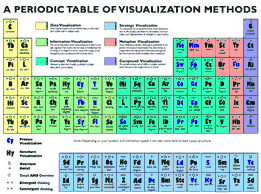 Getting organized typically requires that we find ways to document or illustrate what we do to make it easier to follow. We frequently use business diagrams for that purpose. Getting organized typically requires that we find ways to document or illustrate what we do to make it easier to follow. We frequently use business diagrams for that purpose.
I recently came across an intriguing collection of diagrams, maps, charts, and other commonly used business visualization tools at an interesting site called Visual-Literacy.org.
The international team who compiled that collection devised an ingenious way to display it from a central map. To see it, you can follow this link to "A Periodic Table of Visualization Methods."
At first glance, it resembles the familiar periodic table of physical elements; however, that is where the similarity ends. Each cell in the this "periodic table" represents a different type of business diagram. When you move your on-screen pointer over each cell, an example of that diagram opens in a floating layer, and remains visible until you move your pointer away. The effect is very clever and innovative!
What are the benefits of this collection? For one, if you have forgotten what a particular diagram looks like, or you want to research which type of business tool might best serve your needs, these examples are excellent memory joggers and great sources of information.
|
|
 |
7 Tips for Developing Systems for Success
by Adele Sommers
Wherever you are today with respect to growing your business or organization, developing systems and processes represents a crucial part of setting the conditions for success. In a previous article, I discussed the importance of establishing a robust foundation before your business explodes with new business. This article expands on that theme with seven considerations for systematizing your organization.
Before your company can respond to rapid shifts or prepare for expansion, you will want to look around for leaks and cracks. Ask, "How do communications and work products flow from suppliers, within the organization, and to customers? Who hands off what to whom? Is this ideal or should we optimize processes?"

The answers may reveal areas where no methods exist, where methods are still too vaguely defined to cement, and where critical gaps reside that should be sealed before everyone can perform effectively on a grander scale.
For example, it might be comfortable in the early stages of a business for people to communicate very informally. However, informal communication by itself cannot support a consistent way of operating once more people become involved. If you plan for growth by systematizing as soon as possible, you'll lay a solid framework and avoid an "implosion" later.
Another major consideration is the amount of irreplaceable intellectual property that might be stored in the heads of your employees or contractors. Contributors to your organization might ebb and flow without your retaining a fraction of what they know. Can you afford to let them walk away without capturing their wisdom in your company's knowledgebase? Can people go on vacation without causing a standstill?
Take Time to Do a Little "Task Triage"
Look at each of the applicable areas of your business, such as:
-
 Administration Administration
- Project management
- Production management
- Information technology
- Quality assurance
- Marketing/sales
- Customer support
- Other functional activities
In each area -- and even more importantly, across areas -- you'll find possibilities for streamlining, strengthening, and documenting your processes. Many processes will begin in one functional area and continue through other areas before completion.
The handoffs between people or functions often represent the weakest links because of the possibilities for miscommunication, bottlenecks, delays, and data entry errors. So be especially alert to those areas!
Seven Things to Consider When Systematizing Your Business
As you proceed to develop and fine-tune your processes, consider the following.
1. How mature are your processes?
Especially while in a startup mode, many of your methods might be in a "mushy," formative state. It can take time to develop a repeatable pattern for accomplishing work. Even if your business has operated for a while, new activities will inevitably emerge. Consider whether each is mature enough to justify formal documentation, or whether less formal "desk instructions" would suffice in the meantime. |
2. Can you streamline processes before documenting them?
Before documenting your processes:
- Evaluate whether all activities are truly necessary.
- Consider where activities can be simplified, automated, or eliminated.
- Research where obstacles to productivity exist. (More information.)
- Ponder all areas with the greatest potential for waste, errors, mistakes, and hidden drains on your bottom line.
- Think about how streamlining each area would improve your profitability, customer satisfaction, and internal effectiveness, and prioritize your efforts accordingly.
|
3. Who should document your systems?
People often don't have the "extra" time to document their own tasks, since they already spend all of their time doing their regular jobs. Another option might involve "job shadowing," where an intern or new-hire continually observes, discusses, and documents what an expert performer does.
This relieves the expert of that burden, while providing a way for the intern to learn and contribute value immediately. Alternatively, you could hire a procedure specialist, and if a client engagement benefits enough to pay for it, that's ideal!
The intern or specialist also can recommend ideas for improvement that surface from a having a fresh perspective. All resulting procedures would be fine-tuned with the expert's help and become part of the company's information library. |
4. How can you go about systematizing?
Begin by asking, "How do we [...]?" and then fill in the blank with the activity you wish to systematize. Diagram all steps required to complete that process, across all functional areas.
You may discover that if you routinely perform certain steps in a given order, those are good candidates for step-by-step procedures. In areas where the steps vary based on the circumstances, a list of guidelines might be more appropriate. If you are able to automate procedures, consider using electronic support systems. |
5. What types of documentation should you produce?
- Systems, at the highest level, represent collections of related processes.
- Processes, depicted as diagrams or process maps, provide overviews of tasks that transform inputs into outputs by adding value during each task step.
- Procedures cover the step-by-step, "how-to" details for performing task steps. Procedures might appear in training materials, job aids, and work instructions. Similarly, guidelines show what rules to follow in more variable situations. (More ideas.)
|
6. What can you delegate or outsource?
If you have designed your processes to be easy to follow and repeatable, so that others can produce the same result each time, you are ready to delegate. And if you can hand off to someone with less expertise without losing speed or quality, hurray! |
7. What can you continuously improve?
Always be alert for ways to eliminate, automate, or simplify every activity that you perform routinely. Your time is valuable, so your goal should be to spend time on the activities that will contribute most to your company's profitability. For every step, ask, "What value does this add? What's a faster, less complicated way of getting this done? Can a different view of this system expose new possibilities for streamlining?" |
In conclusion, systematizing your business may seem like an overwhelming effort. But if you prioritize the areas to simplify and document according to what will have the greatest impact on your bottom line, and enlist outside help, you'll be well on the road to success.
Copyright 2007 Adele Sommers
|
|
 |
|
Take the "Getting Organized" Poll
Getting organized isn't easy! In my work as a business consultant, I know just how difficult it can be. So to help reduce the learning curve for everyone, I'm asking you to share your greatest challenge with systems, processes, and procedures so that I can address them in future newsletters.
Thank you very much for your comments, and please stay tuned for more discussion in future newsletter issues on your specific topics of interest!
|
|
 |
|
Adele Sommers, Ph.D. is the author of "Straight
Talk on Boosting Business Performance" -- an award-winning
Special Report and Workbook program.
If you liked today's issue, you'll love this down-to-earth
overview of how 12 potent business-boosting strategies
can reenergize the morale and productivity of your enterprise,
tame unruly projects, and attract loyal, satisfied customers.
It's accompanied by a step-by-step workbook designed
to help you easily create your own success action plan.
Browse the table of contents and reader reviews on the
description page.
Adele also offers no-cost articles and resources to
help small businesses and large organizations accelerate
productivity and increase profitability. Learn more
at LearnShareProsper.com.
LearnShareProsper.com/Business Performance_Inc.,
7343 El Camino Real, Suite 125, Atascadero, CA 93422,
USA. For information and Customer Service, call +1-805-462-2187,
or e-mail Info@LearnShareProsper.com. |
|
| |
|
|
| |
|
©2007
Business Performance_Inc., Adele Sommers, All rights
reserved. www.LearnShareProsper.com
Your feedback is always appreciated!
Write to us at info@LearnShareProsper.com.
We respect your privacy and do not give out or sell
subscriber names or e-mail addresses.
Please use the links below to take
yourself off our list or change your e-mail address.
|
|
|