|
|
April 2, 2009
Volume 5, Issue 7
"How-to" tips and advice on increasing
business prosperity, published every other
Thursday.
To change subscription options, please
see the end of this message.
Sign
me up for this newsletter! |
|
Greetings!
-- Feature Article: How to Reduce, Remove, or Reverse the Risks for Your Clients and Partners (Part 2)
-- Note from the Author: Make Bold Promises You Can Keep
-- Special Message: More Tips on Extraordinary Risk Reversal
-- The Author Recommends: Just for Fun -- The Rapping Airline Attendant (2-minute video)
Please add "Adele@LearnShareProsper.com"
to your whitelist or address book in your e-mail program,
so that you have no trouble receiving future issues.
You subscribed at LearnShareProsper.com,
and you're welcome to forward this newsletter to your
colleagues; please just keep the entire message intact.
If you wish to discontinue your subscription, please
use the links at the bottom.
|
|
 |
|
Make Bold Promises You Can Keep
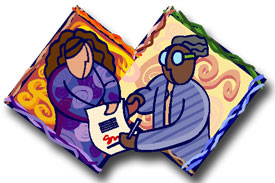
Today, we'll continue the discussion we began in the last newsletter issue on more ways to reverse the risks for clients, partners, and customers. Our goal is to make it much easier for them to say "yes!" to buying your products or engaging your services for their projects, even under volatile economic conditions.
We'll explore more unusual, unique, and even extraordinary approaches to making bold promises that appeal to your audiences and give partners and clients new avenues for doing business with you.
Some approaches might represent calculated risks on your part. But with careful consideration and the proper professional advice, you could craft unique, potent selling propositions that set you apart, by leaps and bounds, from other product producers or service providers.
For these reasons, I hope you enjoy today's features, including "How to Reduce, Remove, or Reverse the Risks for Your Clients and Partners (Part 2)." And please join the conversation by leaving your comments on my blog!
Here's to your business prosperity,

Adele Sommers, author of the "Straight
Talk on Boosting Business Performance" success
program
P.S. If you missed any previous issue, visit
the newsletter index!
|
|
 |
More Tips on Extraordinary Risk Reversal
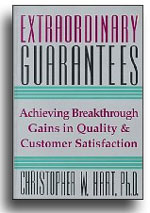 As I was researching the topic of risk-reversal strategies recently, I came upon an older, but interesting book with many relevant stories to tell: "Extraordinary Guarantees: Achieving Breakthrough Gains in Quality and Customer Satisfaction" by Christopher W. Hart (AMACOM, 1993). As I was researching the topic of risk-reversal strategies recently, I came upon an older, but interesting book with many relevant stories to tell: "Extraordinary Guarantees: Achieving Breakthrough Gains in Quality and Customer Satisfaction" by Christopher W. Hart (AMACOM, 1993).
The author explains that the main function of an ordinary warranty is to reduce the customer's sense of risk at the time of purchase. In contrast, "extraordinary guarantees" promise and deliver exceptional, uncompromising quality and satisfaction. They're intended to recapture and retain the customer's goodwill, and "force a company to deliver excellence and to fight to win and retain customer loyalty."
Not only do "extraordinary guarantees" reverse the risk for customers, but they also provide powerful branding opportunities_for organizations. Many businesses have staked their reputations on bold -- or even outrageous -- promises that became their unique selling propositions. (For example, "When it absolutely, positively has to be there overnight," by FedEx.)
The book describes not only extreme promises, but also legitimate conditions that you can place around the promises to keep the risk reversals from becoming a free-for-all. Although incidences of customers "cheating" tend to be relatively few, using conditions can help discourage people from submitting unqualified claims. The author discusses a pest control service, Prism, with both strong promises and a set of constraints. (Prism was later acquired by Orkin, a company with a similar "Triple Guarantee" that I've quoted below and broken into its "promises" and "conditions.")
Promises: When you see a pest . . . your request will receive a response within 24 hours. If during your regularly scheduled treatments you are not completely satisfied with the results, Orkin will re-treat to your satisfaction or refund your last monthly payment. If, after 60 days, you're dissatisfied with Orkin service and decide to cancel, Orkin will pay the reasonable cost of an initial treatment by your choice of pest control operators. If your company is fined by a regulatory agency due solely to a pest infestation, Orkin will reimburse you for any fines paid, not to exceed $50,000*.
 Conditions: *Your account must be current, under contract for more than 60 days, and your business must be compliant with sanitation and structural requests as noted on Orkin service reports. Conditions: *Your account must be current, under contract for more than 60 days, and your business must be compliant with sanitation and structural requests as noted on Orkin service reports.
Using this book as one of your resources, you can brainstorm new ways to make strong, bold, even "extraordinary guarantees" to encourage your customers to act!
|
|
 |
How to Reduce, Remove, or Reverse
the Risks for Your Clients and Partners (Part 2)
by Adele Sommers
In today's challenging business climate, how do you reassure potential clients or partners that it's safe to proceed with projects they may have been considering, but have been putting off because of their concerns about the economy?
Part 1 of this series discussed ways that a service provider (a contractor, vendor, or consultant) could share the risks and rewards of a project venture with clients. This method can greatly expand the options for doing business in uncertain economic times. If you each have the ability to stay afloat while you take calculated risks, you could consider joint project development, followed by a revenue-sharing agreement, such as:
 Becoming "partnering affiliates," where, after a joint product or service is developed and ready for sale, you could use the affiliate module of an online e-commerce system to automatically track accruing revenue splits. This simplifies accounting and boosts the trust levels among partners. Becoming "partnering affiliates," where, after a joint product or service is developed and ready for sale, you could use the affiliate module of an online e-commerce system to automatically track accruing revenue splits. This simplifies accounting and boosts the trust levels among partners.
- Exploring other "share of results" methods, such as splitting a percentage of any royalties, dividing a vested interest in the long-term returns, or a similar equity-sharing arrangement. (Consult an attorney or accountant to assist with any unfamiliar agreements.)
This article, Part 2 in the series, suggests more ways to reduce, remove, and even reverse the risks of doing business, making it far easier for prospective clients and partners to say "yes."
They include using tests, prototypes, and project phases; as well as non-disclosure agreements to protect proprietary ideas. Although these tools are standard in many business situations, each can take on a whole new level of importance and value when creatively applied for risk reduction purposes.
Propose Using Tests, Prototypes, and Project Phases
 One frequent and frustrating project scenario involves a client with a long list of desired features but only a miniscule budget and/or schedule. Negotiations tend to break down easily in such situations. To maneuver through the impasse and jumpstart the project, the parties could consider the following risk-reduction solutions: One frequent and frustrating project scenario involves a client with a long list of desired features but only a miniscule budget and/or schedule. Negotiations tend to break down easily in such situations. To maneuver through the impasse and jumpstart the project, the parties could consider the following risk-reduction solutions:
- Develop and test new processes first. When a project requires designing a new method to produce the deliverables, the unknowns involved can increase the estimate significantly. Therefore, you could propose eliminating unknowns and reducing the estimated price tag by allocating time up front to develop and test the new processes. With some experimentation and fine-tuning, you could optimize those techniques to be both efficient and effective. After neutralizing various risks in this way, your overall project estimates might be substantially lower. This could boost everyone's confidence in moving the project forward.
- Use samples and prototypes to model results. When it's really not clear how long an effort could take, or what the output would look like because the requirements are too vague, you can discuss producing a sample or prototype of the work (such as developing one widget, editing one chapter of a book, or completing one training module). The results would help the stakeholders get a feel for the complexity of the work and understand what is possible to produce. These samples also would allow all parties to fine-tune the requirements before completing the estimate and committing to the entire project.
- Reverse the risk of testing and prototyping. If you're a service provider who's anxious to move a project forward, and you also have sufficient financial reserves to bear this particular risk, you could test new methods and/or create samples on your own time. You could use small, low-budget, incremental tests to verify many kinds of assumptions. After reviewing the completed test results or work samples with your prospective clients, you would be able to estimate the remainder of the project with much more accuracy. Or, you and the clients could take the alternate route of sharing downstream revenues, as explained in Part 1 of this series.
 Propose completing the project in stages. If the parties are trying to muddle their way through an open-ended and unclear set of requirements, you could propose completing the project in phases. Phases allow the features, functions, and deliverables to be defined over time. Another reason to use phases would be to kick off a project with a tiny budget or schedule, and do only a small, foundational subset in Phase 1. Propose completing the project in stages. If the parties are trying to muddle their way through an open-ended and unclear set of requirements, you could propose completing the project in phases. Phases allow the features, functions, and deliverables to be defined over time. Another reason to use phases would be to kick off a project with a tiny budget or schedule, and do only a small, foundational subset in Phase 1.
Focusing only on Phase 1 initially lays the groundwork for future expansion. The stakeholders could then decide whether to add or refine features in later phases. A decision regarding whether to proceed to Phase 2 could depend on successfully testing, using, and/or marketing the Phase 1 results.
As a Service Provider, Offer Your Own Non-Disclosure Agreement
 Another angle that could set a service provider distinctly apart from other professionals, and further reduce the risk for potential clients, would be to routinely offer non-disclosure agreements (NDAs) as part of doing business. Another angle that could set a service provider distinctly apart from other professionals, and further reduce the risk for potential clients, would be to routinely offer non-disclosure agreements (NDAs) as part of doing business.
Instead of waiting for the client to bring up the need, you can do it proactively as you offer your services. That way, you could more easily pursue projects that involve "ghost authoring" or behind-the-scenes development of books, training, or designs that the client would later be selling under his or her own name. You would simply advertise this benefit in your service package as one way you put your client's mind at ease!
In conclusion, even in uncertain business climates, service providers can reduce, remove, or reverse the risks for clients with worries about cashflow. Using creative approaches such as partnering, results sharing, preliminary testing, prototyping, and NDAs, you can keep the project options flowing despite the challenging times.
©2009 Adele Sommers
|
|
 |
|
Just for Fun -- The Rapping Airline Attendant
Want to enjoy a laugh and a good 2-minute rap?
Forget those old, boring passenger safety instructions that most people tune out. They've taken on a whole new spin as Dave, the Southwest Airlines rapping flight attendant, gets the audience rockin'!
|
|
 |
|
Adele Sommers, Ph.D. is the author of "Straight
Talk on Boosting Business Performance" -- an award-winning
Special Report and Workbook program.
If you liked today's issue, you'll love this down-to-earth
overview of how 12 potent business-boosting strategies
can reenergize the morale and productivity of your enterprise,
tame unruly projects, and attract loyal, satisfied customers.
It's accompanied by a step-by-step workbook designed
to help you easily create your own success action plan.
Browse the table of contents and reader reviews on the
description page.
Adele also offers no-cost articles and resources to
help small businesses and large organizations accelerate
productivity and increase profitability. Learn more
at LearnShareProsper.com.
LearnShareProsper.com/Business Performance_Inc.,
7343 El Camino Real, Suite 125, Atascadero, CA 93422,
USA. For information and Customer Service, call +1-805-462-2187,
or e-mail Info@LearnShareProsper.com. |
|
| |
|
|
| |
|
©2008
Business Performance_Inc., Adele Sommers, All rights
reserved. www.LearnShareProsper.com
Your feedback is always appreciated!
Write to us at info@LearnShareProsper.com.
We respect your privacy and do not give out or sell
subscriber names or e-mail addresses.
Please use the links below to take
yourself off our list or change your e-mail address.
|
|
|