|
|
April 5, 2007
Volume 3, Issue 7
"How-to" tips and advice on increasing
business prosperity, published every other
Thursday.
To change subscription options, please
see the end of this message.
Sign
me up for this newsletter! |
|
Greetings!
- Feature Article: A Tribute to an Extraordinary Project-Based, Learn-by-Doing Program
- Note from the Author: Spring Project Planning Mania!
- Special Message: What's in Your Master Plan?
Please add "Adele@LearnShareProsper.com"
to your whitelist or address book in your e-mail program,
so that you have no trouble receiving future issues.
You subscribed at LearnShareProsper.com,
and you're welcome to forward this newsletter to your
colleagues; please just keep the entire message intact.
If you wish to discontinue your subscription, please
use the links at the bottom.
|
|
 |
|
Spring Project Planning Mania!
 In the Northern Hemisphere, we await the start of spring each year to dispel the winter doldrums and inspire us all to move forward with implementing new ideas and continuing work on unmet goals. In the Northern Hemisphere, we await the start of spring each year to dispel the winter doldrums and inspire us all to move forward with implementing new ideas and continuing work on unmet goals.
Project planning tools and techniques are usually high on our priority lists, whether for kicking off a new business project, starting a community effort, reorganizing our places of work, or even planting a new garden. In each situation, we can benefit from using tools that keep us organized and methods that help us focus on every aspect of a successful undertaking.
For these reasons, I hope you enjoy today's features, including the article, "A Tribute to an Extraordinary Project-Based, Learn-by-Doing Program." I'll be waiting for your comments!
Here's to your business prosperity,

Adele Sommers, author of the "Straight
Talk on Boosting Business Performance" success
program
P.S. If you missed any previous issue, visit
the newsletter index!
|
|
 |
|
What's in Your Master Plan?
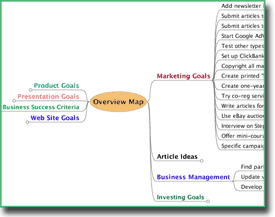 To keep my "millions" of project and related ideas neatly collected in one ever-expanding and flexible location, I've been using a mind mapping tool called FreeMind. To keep my "millions" of project and related ideas neatly collected in one ever-expanding and flexible location, I've been using a mind mapping tool called FreeMind.
FreeMind is not only *free* (as in open source software), but it is also cross-platform compatible. The latter is a big plus, since I constantly work back and forth between my Mac OS and Windows platforms, and love to use applications that will follow me to either location.
FreeMind, like other mind mapping tools, enables me to jot down brainstorming ideas, make notes about the books I'm reading, outline goals and to-do lists, and so forth. Expandable nodes and branches in the map allow me to bounce back and forth between subjects in a non-linear way. This tool also could help me keep track of projects and subtasks; manage links to related files and sources of information; and capture the Web addresses from any Internet research I've been conducting.
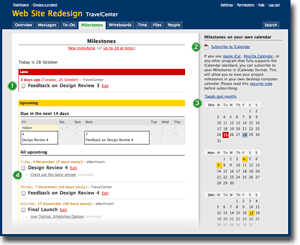 Want to organize your project collaborators without resorting to expensive desktop software? Want to organize your project collaborators without resorting to expensive desktop software?
Basecamp, a Web-based tool, offers a flexible alternative to the more complex and costly project management programs. You can use it on any platform via your Web browser (Internet Explorer 6/7, Firefox, or Safari).
Basecamp is not designed to be a rigorous project planning tool, but allows you to do things such as identify and track milestones, project contributors, tasks, and completion statuses; upload and store project files; and have all team members view their to-do lists and schedules. There are also reports and collaboration tools available.
For a single project with only two participants and no file storage needs, one can sign up for a no-cost account, and there are also several fee-based options available.
|
|
 |
A Tribute to an Extraordinary
Project-Based, Learn-by-Doing Program
by Adele Sommers
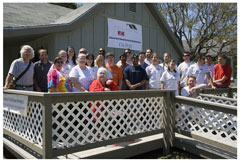
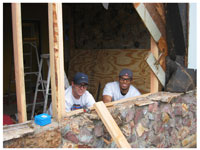
 Dr. Roya Javadpour, a professor of Industrial and Manufacturing Engineering at California Polytechnic University (Cal Poly) at San Luis Obispo, and her business and industrial engineering students don't look like construction experts -- and they're not. Dr. Roya Javadpour, a professor of Industrial and Manufacturing Engineering at California Polytechnic University (Cal Poly) at San Luis Obispo, and her business and industrial engineering students don't look like construction experts -- and they're not.
Yet they're the protagonists in an extraordinarily heartwarming annual undertaking that makes most "extreme home make-over" television shows look amateurish. This article offers a glimpse into some of the dazzling results her students have achieved, based on presentations Roya has given to our local PMI and STC professional groups.
When Dr. Javadpour redesigned her graduate project management course in 2004 to serve disadvantaged county residents, she and her students soon began "a
journey filled with trials and triumphs far grander than they could imagine." Each year since then, students in this course have gained project management skills by planning and completing a home renovation. They raise funds and solicit in-kind donations of tools, building supplies, materials, furnishings, and advice from the community, which allows many others to contribute to the undertaking.
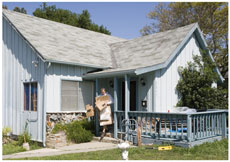
The service project the students chose to complete in the spring quarter of 2006 provided a new start to a disabled grandmother, mother, and daughter whose circumstances prevented them from making many necessary changes to their home. The mother was struggling with both physical disabilities and chronic depression that stemmed from a work-related accident some years ago. She has had back surgeries and severe nerve damage in her legs, which left her in constant pain. The mother is the primary caregiver of her frail and blind 75-year-old mother, as well as her mentally and physically handicapped daughter who lives in the home with them.
"Before and After" Views from the 2006 PolyHouse Project - Exterior
How Does the Program Work?
Since its inception, the PolyHouse program
has sought a very rare kind of client for each spring quarter project --
a person, family, or group that owns a home but is not financially or
physically able to maintain it, due to illness, disabilities, or some other
circumstances. Projects that cannot be considered, for
example, include homes rented out by absentee landlords, or any structure
beset by problems such as mold that cannot be resolved easily and would
pose health risks to students.
Before
each spring quarter starts, Roya contacts many local social service agencies
in a quest for potential clients. Of the few candidates capable of meeting
the eligibility criteria, only one or two typically weigh in as finalists
in the search, especially when the "do-ability criteria" are considered:
 Too
difficult of a project cannot be completed in the allocated timeframe. Too
difficult of a project cannot be completed in the allocated timeframe.
Too
simple of a project will not challenge the students' planning skills.
Once
the finalists emerge, Roya tours the homes with
a licensed contractor to determine which
ones are eligible. The homeowner(s) must also agree to the project and
must be willing to stay completely off-site during the two-week reconstruction
period. When the quarter begins, Roya has the students make the final decision (if there is more than
one option) using the
information she has collected.
A Look at the Expectations
 To successfully plan the project, students must: To successfully plan the project, students must:
- Organize themselves into teams for project planning, fundraising, scheduling, safety, risk assessment, demolition, drywall, construction, painting, window installation, flooring,
landscaping, and more.
- Assess the cost and time tradeoffs of completely
transforming a badly neglected home in just a few weeks.
- Create a work breakdown structure and prepare a variety of project
plans and schedules.
- Create contingency plans in case funding
or other constraints prevent them from carrying out all
of the goals on their wish list.
- Plan all equipment and tools to be used, even
down to the brand name. Students can sometimes borrow tools,
but must buy or rent others. They also must obtain all needed building permits and schedule inspections.
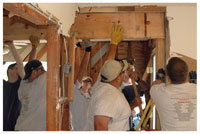 Although the students ultimately choose the size and scope of the project, the main criteria are that the students: Although the students ultimately choose the size and scope of the project, the main criteria are that the students:
- Must finish
what they start, given that significant fine-tuning may occur
during the six-week planning process.
- Must end the project with high
morale, setting the tone for the teamwork, precise
communication, and coordination they will need throughout the project.
Further, the home renovation
project is only part of the course -- students also must master
project management theory, practice, and techniques; take regular
exams; evaluate each other at the end; and provide a personal reflection
essay.
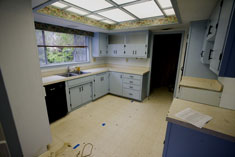
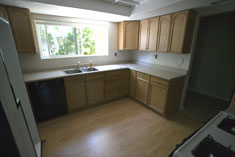
"Before and After" Views from the 2006 PolyHouse Project - Kitchen
How Do the Students Carry Out the Project?
At
the end of six-week planning phase, the students make a
final assessment of whether they can proceed with everything they
had hoped to accomplish, and adjust accordingly. Since they have only four
actual work days (two long weekends) to do all of the work, they prepare to execute every action precisely accordingly to plan. This is especially important for major tasks such as replacing a roof (as in the 2005 project), or moving load-bearing interior walls (as in the 2006 project).
Since
the students are largely untrained in many of the skills required,
they must find someone to tutor and guide
them on-site, or train themselves. For example, they used "how-to"
videos to teach themselves how to tile a bathroom, Roya explained.
Despite the long and grueling hours, where teams typically remain on the site
from very early in the morning to late at night during their four work days, Roya asks them to provide daily status reports at the
end of each work day. Although Roya herself does not perform physical work on the project, she is usually on-site every hour that
the students are there, providing moral support, guidance, and supervision.
And
miraculously, despite performing long hours of rigorous and demanding
physical work for which very few of her students are previously trained --
including demolition, roofing, flooring, and landscaping -- "not
a single person has ever needed more than a Band-Aid," Roya shared -- much to our astonishment.
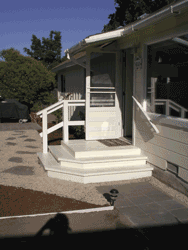
"Before and After" Views from the 2005 PolyHouse Project - Exterior
|
|
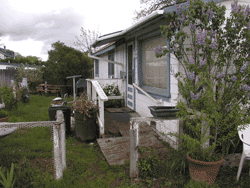
At
the homeowner's request, the unsafe and dilapidated
ramp used previously for wheelchair access (above)
was replaced with steps (right), which aided him
in regaining his mobility. |
|
|
In conclusion, the PolyHouse program provides an unparalleled learn-by-doing experience that gives students enormous confidence and skill. I had the privilege of visiting the 2006 project during a pouring rainstorm as it was nearing completion, and was utterly inspired watching the dedicated crew put the final touches on yet another miraculous transformation.
Copyright 2007 Adele Sommers
=-=-=-=-=-=-=-=-=-=-=-=-=-=-=-=-=-=-=
For more information on the PolyHouse projects, please use the following links:
|
|
 |
|
The Project Management Institute (PMI)

The Society for Technical Communication (STC)

|
|
 |
|
Adele Sommers, Ph.D. is the author of "Straight
Talk on Boosting Business Performance" -- an award-winning
Special Report and Workbook program.
If you liked today's issue, you'll love this down-to-earth
overview of how 12 potent business-boosting strategies
can reenergize the morale and productivity of your enterprise,
tame unruly projects, and attract loyal, satisfied customers.
It's accompanied by a step-by-step workbook designed
to help you easily create your own success action plan.
Browse the table of contents and reader reviews on the
description page.
Adele also offers no-cost articles and resources to
help small businesses and large organizations accelerate
productivity and increase profitability. Learn more
at LearnShareProsper.com.
LearnShareProsper.com/Business Performance_Inc.,
7343 El Camino Real, Suite 125, Atascadero, CA 93422,
USA. For information and Customer Service, call +1-805-462-2187,
or e-mail Info@LearnShareProsper.com. |
|
| |
|
|
| |
|
©2007
Business Performance_Inc., Adele Sommers, All rights
reserved. www.LearnShareProsper.com
Your feedback is always appreciated!
Write to us at info@LearnShareProsper.com.
We respect your privacy and do not give out or sell
subscriber names or e-mail addresses.
Please use the links below to take
yourself off our list or change your e-mail address.
|
|
|