|
|
May 12, 2011
Volume 7, Issue 8
"How-to" tips and advice on increasing
business prosperity, published every other
Thursday.
To change subscription options, please
see the end of this message.
Sign
me up for this newsletter! |
|
Greetings!
- Feature Article: The Eighth Annual PolyHouse: Another Miracle in the Making
- Note from the Author: Spring Is the Season for Project Magic!
- Special Message: Want People to Give Money? First, Ask Them for Time
Please add "Adele@LearnShareProsper.com"
to your whitelist or address book in your e-mail program,
so that you have no trouble receiving future issues.
You subscribed at LearnShareProsper.com,
and you're welcome to forward this newsletter to your
colleagues; please just keep the entire message intact.
If you wish to discontinue your subscription, please
use the links at the bottom.
|
|
 |
|
Spring Is the Season for Project Magic
 Project planning and funding are usually high on our priority lists, whether for kicking off a new business endeavor, supporting a worthy community effort, reorganizing our places of work, or planting a spring garden. Project planning and funding are usually high on our priority lists, whether for kicking off a new business endeavor, supporting a worthy community effort, reorganizing our places of work, or planting a spring garden.
The month of May also heralds a remarkable annual effort by our local university's project management students, an undertaking known as the "PolyHouse Project" that is coordinated by Dr. Roya Javadpour.
This "mission impossible," learn-by-doing program involves completely rebuilding the home and lives of a physically and financially disadvantaged family.
In the span of just 10 short weeks -- with only two long working weekends allocated -- the students perform a brand of project magic unrivaled even by "total makeover" television. Each year's students begin with no capital whatsoever. They must do all necessary fundraising and learn nearly every building technique from scratch. They then meticulously plan every permit, action, nail, and tool, and execute their design plan with astonishing results.
In the area of fundraising, I've also included a potent article by Barry Vanderkelen about seeking donations for charitable causes in a down economy: "Want People to Give Money? First, Ask Them for Time."
For these reasons, I really hope you enjoy today's features, including "The Eighth Annual PolyHouse: Another Miracle in the Making." And please be sure to join the conversation by leaving your comments on my blog!
Here's to your business prosperity,

Adele Sommers, author of the "Straight
Talk on Boosting Business Performance" success
program
P.S. If you missed any previous issue, visit
the newsletter index!
|
|
 |
|
Want People to Give Money? First, Ask Them for Time
by guest author Barry Vanderkelen
A topic of significant interest among nonprofits is how to raise funds during these difficult economic times.
Unfortunately, no one has a magic formula that can be universally applied. A recently published study reinforces the old fundraising adage that people who volunteer give more.
 Researchers Wendy Liu and Jennifer Aaker found that subsequent donations are substantially greater (by more than 40 percent) when people are asked to volunteer time first than if they are asked to give money_first. Their study, "The Happiness of Giving: The Time-Ask Effect," was published in last October's issue of the Journal of Consumer Research. Researchers Wendy Liu and Jennifer Aaker found that subsequent donations are substantially greater (by more than 40 percent) when people are asked to volunteer time first than if they are asked to give money_first. Their study, "The Happiness of Giving: The Time-Ask Effect," was published in last October's issue of the Journal of Consumer Research.
Liu and Aaker argue that asking for someone's time triggers an emotional connection to the cause or organization. This emotional connection enables people to see getting involved as a means towards happiness, which leads to greater giving.
On the other hand, asking for funding first triggers a utilitarian mindset and people feel like they're being treated like a transaction. People respond with such questions as: "Is it worth it?" "Can I afford it?" and "Is the organization run efficiently?"
But this points to a problem: How can an over-stretched nonprofit involve more volunteers when financial support is needed right away?
Start by understanding who is helping already, and ask them to donate.
Both the Obama and McCain presidential campaigns used social networking aggressively. For example, the Obama team asked people to forward an e-mail or a text message to five friends, to twitter observations at an event, and to connect via Facebook and other on-line communities. Then the campaign asked for donations. These techniques helped create the largest donor base of any presidential campaign.
On a much smaller scale, consider asking people to do simple things, such as helping on a project that will take an hour or two to complete.
 Or ask interested people to invite five friends to help; people connect deeply to a cause if they're asked to speak about it. Or ask interested people to invite five friends to help; people connect deeply to a cause if they're asked to speak about it.
In large and small ways, you can connect with people on an emotional level, which will lead to a deeper bond and more substantial donations.
© Barry VanderKelen
Barry VanderKelen is Executive Director of the San Luis Obispo County Community Foundation (sloccf.org) in San Luis Obispo, California. He writes a regular newspaper column to help strengthen nonprofit organizations in the community. This article was excerpted from a column that originally appeared in the San Luis Obispo Tribune and was adapted with permission.
|
|
 |
The Eighth Annual PolyHouse: Another Miracle in the Making
by Adele Sommers
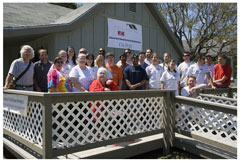
 Dr. Roya Javadpour, a professor of Industrial and Manufacturing Engineering at California Polytechnic State University (Cal Poly) at San Luis Obispo, and her business and industrial engineering students don't look like construction experts -- and they're not. Dr. Roya Javadpour, a professor of Industrial and Manufacturing Engineering at California Polytechnic State University (Cal Poly) at San Luis Obispo, and her business and industrial engineering students don't look like construction experts -- and they're not.
Yet they're the protagonists in an extraordinarily heartwarming annual undertaking that makes most "extreme home makeover" television shows look amateurish. This article offers a glimpse into some of the dazzling results her students have achieved, based on presentations she has given to our local PMI and STC professional groups.
When Dr. Javadpour redesigned her graduate project management course in 2004 to serve disadvantaged county residents, she and her students soon began "a
journey filled with trials and triumphs far grander than they could imagine." Each year since then, students in this course have gained project management skills by planning and completing a home renovation. They raise funds and solicit in-kind donations of tools, building supplies, materials, furnishings, and advice from the community, which allows many others to contribute to the undertaking.
The service project the students will complete in May of 2011 will aid a 16-year-old disabled teenager who was born with a severe form of spina bifida. He is paralyzed from the chest down and has been confined to a wheelchair ever since the age of two. Over his lifetime, this teen has endured twelve major surgeries and countless other hospitalizations. Furthermore, he suffers from hydrocephalus (water on the brain) and osteoporosis, which greatly affect his executive functioning skills.
Daily living tasks require constant prompting and a great deal of assisted care. His parents make every possible accommodation for their son, but as he has grown over the years, the physical demands of caring for him have taken a toll.
The students' goals are to improve the safety and comfort of the family's home and also to encourage his future independence. They plan to build a larger bedroom and a wheelchair-accessible bathroom, and provide other much-needed renovations that would otherwise go undone. These will allow the family to manage his daily medical needs with less overall stress, as well as bring great hope to him.
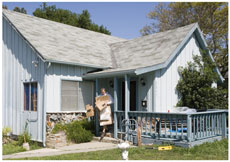
"Before and After" Views from an Earlier PolyHouse Project - Exterior
How Does the Program Work?
Since its inception, the PolyHouse program
has sought a very rare kind of client for each spring quarter project --
a person, family, or group that owns a home but is not financially or
physically able to maintain it, due to illness, disabilities, or some other
circumstances. Projects that cannot be considered, for
example, include homes rented out by absentee landlords, or any structure
beset by problems such as mold that cannot be resolved easily and would
pose health risks to students.
Before
each spring quarter starts, Roya contacts many local social service agencies
in a quest for potential clients. Of the few candidates capable of meeting
the eligibility criteria, only one or two typically weigh in as finalists
in the search, especially when the "do-ability criteria" are considered:
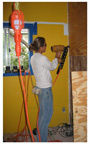 Too
difficult of a project cannot be completed in the allocated timeframe. Too
difficult of a project cannot be completed in the allocated timeframe.
Too
simple of a project will not challenge the students' planning skills.
Once
the finalists emerge, Roya tours the homes with
a licensed contractor to determine which
ones are eligible. The homeowner(s) must also agree to the project and
must be willing to stay completely off-site during the two-week reconstruction
period. When the quarter begins, Roya has the students make the final decision (if there is more than
one option) using the
information she has collected.
A Look at the Expectations
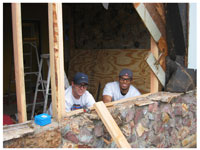 To successfully plan the project, students must: To successfully plan the project, students must:
- Organize themselves into teams for project planning, fundraising, scheduling, safety, risk assessment, demolition, drywall, construction, painting, window replacement, flooring,
landscaping, and more.
- Assess the cost and time tradeoffs of completely
transforming a badly neglected home in just a few weeks.
- Create a work breakdown structure and prepare a variety of project
plans and schedules.
- Create contingency plans in case funding
or other constraints prevent them from carrying out all
of the goals on their wish list.
- Plan all equipment and tools to be used, even
down to the brand name. Students can sometimes borrow tools,
but must buy or rent others. They also must obtain all needed building permits and schedule inspections.
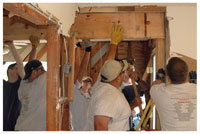 Although the students ultimately choose the size and scope of the project, the main criteria are that the students: Although the students ultimately choose the size and scope of the project, the main criteria are that the students:
- Must finish
what they start, given that significant fine-tuning may occur
during the six-week planning process.
- Must end the project with high
morale, setting the tone for the teamwork, precise
communication, and coordination they will need throughout the project.
Further, the home renovation
project is only part of the course -- students also must master
project management theory, practice, and techniques; take regular
exams; evaluate each other at the end; and provide a personal reflection
essay.
"Before and After" Views from the Earlier PolyHouse Project - Kitchen
How Do the Students Carry Out the Project?
At
the end of six-week planning phase, the students make a
final assessment of whether they can proceed with everything they
had hoped to accomplish, and adjust accordingly. Since they have only six
actual work days (two long weekends) to do all of the work, they prepare to execute every action precisely accordingly to plan. This is especially important for major tasks such as replacing a roof (as in the 2005 project), or moving load-bearing interior walls (as in the 2006 project).
Since
the students are largely untrained in many of the skills required,
they must find someone to tutor and guide
them on-site, or train themselves. For example, they used "how-to"
videos to teach themselves how to tile a bathroom, Roya explained.
Despite the long and grueling hours, where teams typically remain on the site
from very early in the morning to late at night during their four work days, Roya asks them to provide daily status reports at the
end of each work day. Although Roya herself does not perform physical work on the project, she is usually on-site every hour that
the students are there, providing moral support, guidance, and supervision.
And
miraculously, despite performing long hours of rigorous and demanding
physical work for which very few of her students are previously trained --
including demolition, roofing, flooring, and landscaping -- "not
a single person has ever needed more than a Band-Aid," Roya shared -- much to our astonishment.
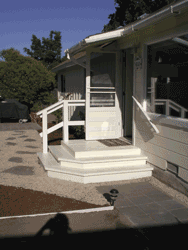
"Before and After" Views from Another PolyHouse Project - Exterior
|
|
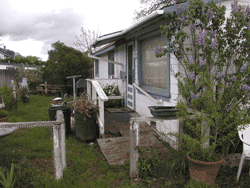
At
the homeowner's request, the unsafe and dilapidated
ramp used previously for wheelchair access (above)
was replaced with steps (right), which aided him
in regaining his mobility. |
|
|
In conclusion, the PolyHouse program provides an unparalleled learn-by-doing experience that gives students enormous confidence and skill. I've had the privilege of visiting one project during a pouring rainstorm as it was nearing completion, and another project in which everyone was sweltering in searing heat. I was repeatedly inspired by watching the dedicated crews put the final touches on each miraculous transformation.
Copyright 2011 Adele Sommers
=-=-=-=-=-=-=-=-=-=-=-=-=-=-=-=-=-=-=
For more information on the PolyHouse projects (and to make online donations), please use the following links:
|
|
 |
|
The Project Management Institute (PMI)

The Society for Technical Communication (STC)

|
|
 |
|
Adele Sommers, Ph.D. is the author of "Straight
Talk on Boosting Business Performance" -- an award-winning
Special Report and Workbook program.
If you liked today's issue, you'll love this down-to-earth
overview of how 12 potent business-boosting strategies
can reenergize the morale and productivity of your enterprise,
tame unruly projects, and attract loyal, satisfied customers.
It's accompanied by a step-by-step workbook designed
to help you easily create your own success action plan.
Browse the table of contents and reader reviews on the
description page.
Adele also offers no-cost articles and resources to
help small businesses and large organizations accelerate
productivity and increase profitability. Learn more
at LearnShareProsper.com.
LearnShareProsper.com/Business Performance_Inc.,
7343 El Camino Real, Suite 125, Atascadero, CA 93422,
USA. For information and Customer Service, call +1-805-462-2187,
or e-mail Info@LearnShareProsper.com. |
|
| |
|
|
| |
|
©2011
Business Performance_Inc., Adele Sommers, All rights
reserved. www.LearnShareProsper.com
Your feedback is always appreciated!
Write to us at info@LearnShareProsper.com.
We respect your privacy and do not give out or sell
subscriber names or e-mail addresses.
Please use the links below to take
yourself off our list or change your e-mail address.
|
|
|