Implementing Your Vision:
Designing a Road Map for Success
by Adele Sommers
A visioning process offers a profound and transformative sharing experience that can tap deeply into the subconscious interconnectedness among the participants. It enables groups, organizations, or communities to conduct strategic planning, rethink organizational dynamics, resolve conflicts, and imagine all new possibilities. Once the visioning exercise is completed, it sets the stage for a focusing exercise to identify implementation goals, potential obstacles, actions, partners, and resources.
 This article discusses three aspects of vision implementation: This article discusses three aspects of vision implementation:
1. Clarifying your big-picture "build-out" plan
2. Identifying potential partners and resources
3. Determining goals, obstacles, actions, and evaluation criteria
Clarifying Your Big-Picture "Build-Out" Plan
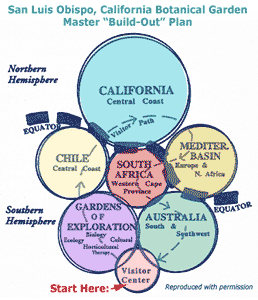
Your visioning exercise helped you explore uncharted territory to identify a single shared vision statement, or perhaps a collection of vision themes. If a set of themes emerged, each may represent an aspect of your "build-out," or implementation plan.
What will it look like when it's complete? As Dr. Stephen Covey recommends in Habit 2 of The Seven Habits of Highly Effective People, "Begin with the End in Mind," and focus on the long-term results. You might want to capture your completed vision in one or more ways:
- A written narrative from participants' responses during the visioning exercise
- A set of drawings or sketches that participants may have generated
- Diagrams or models representing various aspects of the vision

Next, start high-level planning. Regardless of how complex, expansive, or costly your vision is, can you break it into modular "chunks" that could be phased in over time? Consider whether the long-range realization can occur in stages as more funds, information, and resources become available.
For example, if your vision entails starting a new community center, perhaps your first phase should involve finding the expertise and resources to prepare a detailed master plan. The master plan would then become an essential means of attracting the funding, expertise, and resources for the next modular chunk, and so on.
Identifying Potential Partners and Resources
Who might help you achieve your vision? Are there possible partners, collaborators, or agencies that could lessen your load and provide a source of ideas, influence, or expertise?
What resources can you tap to accelerate your progress? For example, can you access funds, plans, ideas, blueprints, experts, or models from similar past projects? List the potential partners and resources.
Potential Partners |
Possible Resources |
1. |
1. |
2. |
2. |
3. |
3. |
Determining Goals, Obstacles, Actions, and Evaluation Criteria
When the magnitude of either a "grand vision" or smaller-scale undertaking seems overwhelming, it's easy to allow procrastination and obstacles -- real or perceived -- to block progress. To forge past this dilemma, use the six steps below to identify:
- A set of more detailed goals for the phases you've identified
- A set of obstacles that might prevent you from achieving those goals
- A set of intermediate objectives that would resolve each obstacle
- The prioritized order in which to proceed
- Ways to measure the results
- A set of action steps to take
Step 1. Make a list of goals you intend to achieve.
What is the purpose of each phase, and what do you expect to accomplish? What goals would help you fulfill them? You can create separate lists of goals for each phase, as desired.
Our Phase 1 purpose is to: |
Goals that will lead us to fulfill Phase 1 are: |
| |
1. |
| 2. |
| 3. |
Step 2. Identify obstacles that appear to block your goals.
Brainstorm with "sticky notes" all of the reasons why you cannot fulfill your goal(s). Be candid with what you perceive to be an obstacle. State each one in the present tense, in terms of what actually exists, rather than as a future possibility.
Obstacles to Phase 1 Goals
Examples:
a) The project depends on our securing a permit that we don’t have.
b) We don’t have the right team to do the work. |
| 1. |
| 2. |
| 3. |
Step 3. List a set of intermediate objectives that can eliminate each obstacle.
These types of objectives should state a way to either eliminate an obstacle or work around it. Each objective should be feasible. State each in the present tense, as if it were in place today. Brainstorm as many objectives as possible for each obstacle, then select the best option.
Obstacles
Example: The project depends on our securing a permit that we don’t have. |
Intermediate Objectives
Examples of solutions to the obstacle:
a) We implement a different method that doesn't need a permit.
b) We obtain the permit. |
1. |
1.
2.
3. |
2. |
1.
2.
3. |
Step 4. Sequence the intermediate objectives by feasibility or priority.
Analyze the list of intermediate objectives, and figure out how to put them in the proper sequence. Which ones should come first, second, and third? If you see that some objectives are building blocks for others, determine the order in which to proceed.
Hint: Before creating a list or table, first use sticky notes to spatially arrange the objectives on paper. Place the objectives that should occur first at the bottom of the paper, and move up the paper with objectives that address later obstacles. Draw arrows between them to show which objectives depend on which others occurring first. When you've finished this diagram, complete the table below.
List of Intermediate Objectives |
Sequence |
1. |
|
2. |
|
3. |
|
Step 5. Determine your evaluation criteria.
How will you know when your objectives have been achieved? How will you define success? Identify some kind of criteria that will verify whether you have succeeded.
List of Intermediate Objectives |
Sequence |
Evaluation Criteria |
1. |
|
|
2. |
|
|
3. |
|
|
Step 6. Take action to implement the prioritized objectives.
Each objective requires a set of actions to complete it. For example, to obtain a permit, you might need to 1) contact an agency, 2) fill out an application, and 3) send it in.
List of Intermediate Objectives |
Action Steps |
1. |
1.
2.
3.
|
2. |
1.
2.
3. |
In conclusion, implementing a vision involves a focusing exercise that takes an idealistic goal and turns it into a blueprint for action. By identifying implementation goals, actions, evaluation criteria, partners, and resources, you'll create a logical and feasible road map for success.
Copyright 2007 Adele Sommers
|





 I've noticed, however, that eventually breakthroughs do occur even for the most challenging issues. That's when suddenly, everything begins to "click," the progress begins to "stick," and I find myself moving forward every day!