|
|
July 26, 2007
Volume 3, Issue 15
"How-to" tips and advice on increasing
business prosperity, published every other
Thursday.
To change subscription options, please
see the end of this message.
Sign
me up for this newsletter! |
|
Greetings!
- Feature Article: 10 Strategies for Successful Beta Testing
- Note from the Author: Building in Quality from the Ground Up
- Special Message: Is Your First Design Idea the Best One?
Please add "Adele@LearnShareProsper.com"
to your whitelist or address book in your e-mail program,
so that you have no trouble receiving future issues.
You subscribed at LearnShareProsper.com,
and you're welcome to forward this newsletter to your
colleagues; please just keep the entire message intact.
If you wish to discontinue your subscription, please
use the links at the bottom.
|
|
 |
|
Building in Quality from the Ground Up
 In the last two newsletter issues, we have been discussing a potent formula for building quality incrementally into your offerings to create the greatest possible competitive advantages. This formula involves a range of methods for testing and evaluating your products and services to achieve the very best possible results. In the last two newsletter issues, we have been discussing a potent formula for building quality incrementally into your offerings to create the greatest possible competitive advantages. This formula involves a range of methods for testing and evaluating your products and services to achieve the very best possible results.
Why is this important? Consumers are rightfully "underwhelmed" by the plethora of defective, complex, confusing, and time-wasting items that exist in the marketplace today. In contrast, the same consumers would reward reliable, bug-free, elegant, simple, and easy-to-use products and services with tremendous loyalty and devotion.
Beta testing represents an essential validation process that most people have heard of, but might not be familiar with how to perform. Whenever it's conducted effectively, it usually requires several iterations, so you'll want to be sure to schedule and budget these efforts in your initial project planning.
For these reasons, I hope you enjoy today's feature, "10 Strategies for Successful Beta Testing." And please continue sending your terrific insights and feedback!
Here's to your business prosperity,

Adele Sommers, author of the "Straight
Talk on Boosting Business Performance" success
program
P.S. If you missed any previous issue, visit
the newsletter index!
|
|
 |
|
Is Your First Design Idea the Best One?
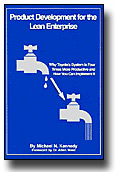 In my last newsletter, I discussed how in the requirements phase, you can assess whether your initial design ideas for a Web site, system, product, or custom solution are the very best ones by comparing design alternatives. To do this, you would methodically mock up, test, and evaluate not just one, but several competing prototypes -- each of which embodies a different set of features, functions, or characteristics. You would do this before cementing the requirements for your design. Toyota has been using this approach for decades with extraordinary success, so I thought you might enjoy some additional information on this approach. In my last newsletter, I discussed how in the requirements phase, you can assess whether your initial design ideas for a Web site, system, product, or custom solution are the very best ones by comparing design alternatives. To do this, you would methodically mock up, test, and evaluate not just one, but several competing prototypes -- each of which embodies a different set of features, functions, or characteristics. You would do this before cementing the requirements for your design. Toyota has been using this approach for decades with extraordinary success, so I thought you might enjoy some additional information on this approach.
In Product Development for the Lean Enterprise: Why Toyota's System Is Four Times More Productive and How You Can Implement It, author Michael Kennedy unveils, via a compelling account of a fictional company in crisis, how to use the techniques that Toyota has perfected to turn a business completely around -- even if it is in an entirely different industry from car manufacturing. The lessons learned on design evaluation techniques and project risk management can apply to many industries.
Why is this important? One pitfall in
our design culture is our tendency to become riveted on a single
design early in the system development life cycle, without ever evaluating
other alternatives in depth. The problem with this approach is that if the design turns out to be unworkable later in the life cycle, it usually means going back
to the drawing board for another potentially long round of
design and development. Backtracking in this way is typically costly and time-consuming.
In contrast, Toyota's approach has been to model
a variety of alternatives at the outset by creating a series of prototypes, and then testing them extensively to see which ones perform the very best. Afterward, the project team derives a final set of requirements by combining the superior features, functions, and/or characteristics from
the best performing prototypes. The final design therefore tends to be far more robust, high-performing, cost-effective, and reliable than any of the initial concepts would have been. So, how might you apply these ideas to your situation?
|
|
 |
10 Strategies for Successful Beta Testing
by Adele Sommers
Successful beta testing starts in the earliest stages of project planning. Why is that? Because beta testing is meant to involve a methodical prove-in of a carefully planned system. It's not meant to be a hit-or-miss, cross-your-fingers-and-hope-everything's-OK Band-Aid that you can apply at the last minute. This article (Part 3 in a series; see Part 1 and Part 2 here) discusses ten tips for performing this crucial activity. But first of all, why is it so important?
We've all seen examples of products -- even some from well-known, respectable companies -- that arrive on our desktops barely breathing. They seem to be so full of bugs that they cause us more grief than they help us carry out work. Or we try to use a Web site that looks great, but we can't get from the shopping cart to the order page. Or we buy a new device, yet even using the instruction booklet, we can't carry out critical functions the way we're supposed to. 
Are you anxious to frustrate your customers this way?
Of course not! That's why beta testing involves such a systematic, tedious, yet indispensable sequence of activities. But without a method to the madness, you are only randomly banging on the system to see if by chance you can find a way to break it.
What should you be striving to accomplish? Using the checklist that appears below, you will want to determine whether your product or system will:
- Function without bugs or snags. The test procedure should validate the features embodied in the system against those called for in the specification. It also should call for testing extreme data as well as typical data, and test the features in combination with one another in many different sequences. These permutations represent how actual customers will behave -- unpredictably! A system should either prevent, or smoothly respond to, awkward situations.
- Guide people to achieve their primary aims. Beta testing can examine the "big picture" aspects as well as the detailed minutiae. Can users successfully complete their high-level goals using the onscreen guidance and user guides?
- Handle extreme circumstances gracefully. Your product or service should deliver helpful, intelligent responses in any extreme conditions, such as when people might be stranded, working alone, or battling the elements. At the very least, the system should cause no confusion and inform users of their options.
Beta Testing Checklist
Below are 10 strategies for achieving success with planning the beta testing effort, carrying out the process, and keeping the testers happy.
1. |
Design test scenarios. What's a "test scenario"? Each test scenario should be mirror image of a "use scenario" that's been guiding a team to design and develop the system. A use scenario describes one typical interaction a customer has with the system. For instance, for an automated teller machine (ATM), one scenario could involve a customer inserting a card in order to withdraw some cash. In another scenario, a customer makes a deposit. In another, he or she verifies the balance.
Scenarios must represent any plausible ways in which users could interact with the system, including unusual and unintended actions. So both use scenarios and test scenarios should account for possible error conditions such as jammed cards, cancelled transactions, or overdrawn accounts. |
2. |
Write a test procedure. A test procedure specifies how testers will exercise the test scenarios, including the order to follow, as well as running several tests in random order. It should also explain what results to expect in each case.
You will want the procedure to test all new system features or changes. The procedure should also specify testing features in various combinations. For example, you might specify 1) withdrawing cash, then 2) verifying balance information, and then 3) making a deposit. Be sure to vary the order, and test error conditions. |
3. |
Determine what data you need. If your system stores values in a database, you will need to pre-load some typical data to test the scenarios. In the ATM example, values would include account balances -- for testing withdrawal limits and giving balance information. Create the sample data sets and pre-load the systems to be tested. Don't forget to include extremely high and low values! |
4. |
Plan specific roles for testers. Schedule each tester to focus on specific test scenarios and related data sets. If there are enough testers, assign more than one to cover each test scenario. Each person will approach it differently. |
5. |
Create a bug reporting system. It could be form-based, a database, an e-mail method, or a combination. Have testers submit bug reports as they find errors in each round of testing. |
6. |
Establish a test schedule. The schedule should allow for several iterations of beta testing. Be sure to clear the schedules of testers for each round in which they will be participating. |
7. |
Get all materials ready for testing. The following items should be ready for the kickoff: A new or updated system, lists or descriptions of any bugs fixed, new or updated documentation, test scenarios and procedures, and so on. |
8. |
Set a start date and schedule progress milestones. After the kickoff meeting, if testers find numerous bugs -- or especially critical ones -- before reaching a given milestone, stop testing, fix the bugs and/or documentation, and return to Step 1. Ask before restarting: Are new test scenarios or data sets needed? |
9. |
Perform a new round of testing for each new test baseline. This means starting the complete test from scratch after each round of fixes. You can't sidestep this requirement, because each time something is fixed, it can "break" something else. Stop the cycles of testing only when no new bugs are evident. |
10. |
Plan a reward for a job well done. Testing is very tedious -- so testers need a special incentive to keep them focused on the goal. Although they're helping to produce a high-quality system, a post-testing party wouldn't hurt morale! |
Thorough beta testing is essential for producing quality systems. However, if you discover errors you can't fix in time, you could decide to release a system with known defects (documented in your "Read-me" notes). The stakes can be high, so weigh this option carefully before proceeding.
See LearnShareProsper.com/products.html#value for downloads of the following tools:
- Functional Testing Checklist
- Beta Testing Checklist
Copyright 2007 Adele Sommers
|
|
 |
|
Test Your Web Site with No-Cost Tools
Using the *free* tools available through AvivaDirectory.com/free-online-tests/, you can find out the reading grade level of a particular site's content, whether it is fully compatible with all major browsers, how many seconds it takes to load, and whether it has any broken links. These are just a few of the 31 no-cost online tests linked to this site.
Aviva Directory also provides links to search engine optimization (SEO) tools. Developing a site with an "SEO-friendly" model is a great way to gain an edge on your competition by having more effective ways of appealing to your audiences.
With the SEO tools, you can do things such as display visitor traffic information; find out which sites link back to yours; neatly display Alexa and Google Page Rank stats; analyze and predict the audience and market of your Web site; analyze meta tags, keyword density, and loading time; assess the popularity of a particular Web page; determine how well your site is indexed in search engines; and find out how well you rank for particular keywords. Wow!
|
|
 |
|
Adele Sommers, Ph.D. is the author of "Straight
Talk on Boosting Business Performance" -- an award-winning
Special Report and Workbook program.
If you liked today's issue, you'll love this down-to-earth
overview of how 12 potent business-boosting strategies
can reenergize the morale and productivity of your enterprise,
tame unruly projects, and attract loyal, satisfied customers.
It's accompanied by a step-by-step workbook designed
to help you easily create your own success action plan.
Browse the table of contents and reader reviews on the
description page.
Adele also offers no-cost articles and resources to
help small businesses and large organizations accelerate
productivity and increase profitability. Learn more
at LearnShareProsper.com.
LearnShareProsper.com/Business Performance_Inc.,
7343 El Camino Real, Suite 125, Atascadero, CA 93422,
USA. For information and Customer Service, call +1-805-462-2187,
or e-mail Info@LearnShareProsper.com. |
|
| |
|
|
| |
|
©2007
Business Performance_Inc., Adele Sommers, All rights
reserved. www.LearnShareProsper.com
Your feedback is always appreciated!
Write to us at info@LearnShareProsper.com.
We respect your privacy and do not give out or sell
subscriber names or e-mail addresses.
Please use the links below to take
yourself off our list or change your e-mail address.
|
|
|