Try Any of These 50 Ways to Get to "Yes!"
by Adele Sommers
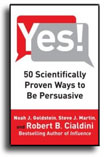
Fifty ways to influence others! That's the magic number in "Yes! 50 Scientifically Proven Ways to Be Persuasive" by researchers Noah Goldstein, Steve Martin, and Robert Cialdini. It's a collection of highly ethical and responsible ways to help people make beneficial buying and behavioral decisions under a variety of circumstances.
 Regardless of the role you play in an organization, Dr. Cialdini and colleagues emphasize that everyone has a need to persuade others in some fashion every day. But rather than having to rely on intuition or gut instinct about how to best go about influencing others, this latest research provides a formulaic approach that takes much of the guesswork out of the equation. Regardless of the role you play in an organization, Dr. Cialdini and colleagues emphasize that everyone has a need to persuade others in some fashion every day. But rather than having to rely on intuition or gut instinct about how to best go about influencing others, this latest research provides a formulaic approach that takes much of the guesswork out of the equation.
The goal is not to apply this "science of persuasion" in a furtive, underhanded, or manipulative sense. The authors explain that by making small changes in our approaches to various business or social situations, we can produce profoundly positive differences and greatly improve relationships with colleagues and consumers.
Follow this link to hear a fascinating, 30-minute interview with Dr. Cialdini and Rich Schefren on various marketing applications of this same material. Some of the key points below derive from both the interview and the book, and are just a few of the countless insights the book reveals.
How Can We Get People to Eagerly Agree to a Request?
Cialdini asserts that if a request has been structured in such a way as to inform an individual as to why it's in his or her best interests to move in a certain direction, no one loses in that situation. People would gladly return to do more business with, or continue to interact with, a person who has responsibly educated them toward making helpful decisions. Taking this approach entails assuming a fiduciary role with respect to one's constituents, where one clearly has only their very best interests at heart.
One of the most intriguing themes around which the persuasion research focuses is compliance.
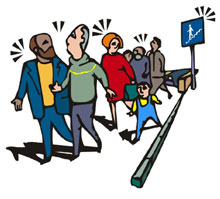 For instance, compliance could be with laws, rules, environmental regulations, or social norms. Cialdini explains that the extent to which we're likely to comply with any type of "request" (legal, social, or other) depends on: For instance, compliance could be with laws, rules, environmental regulations, or social norms. Cialdini explains that the extent to which we're likely to comply with any type of "request" (legal, social, or other) depends on:
- What we hear of or see similar people doing under the same circumstances.
- How rules, signs, or other messages requesting compliance are phrased.
Why is that? Well, particularly in times of uncertainty, people look first to peers -- others who are just like them -- and next to authority figures, to provide them with clues as to which path to take, which choice to make, and so forth.
When we're particularly unsure of what to do, such as in the current economic climate where it's not clear which choices to make, we tend to freeze all activity until we can reduce our uncertainty enough to proceed. By seeing evidence of how other people just like us have successfully followed a certain path under similar conditions, we can feel more confident about moving in the same direction. This tendency holds true even in routine situations where we subconsciously look around for evidence ("social proof") of what's considered appropriate or acceptable behavior.
How Can We Influence People to "Follow the Crowd" in a Beneficial Way?
According to Cialdini, our inclination to follow the herd is so strong that it plays out in myriad ways under different circumstances, with both positive and negative effects. Since this urge is such a reliable indicator of potential action, Cialdini and colleagues carefully point out this behavior is really a double-edged sword. Those who make requests of others must do so very carefully, because just a few words can make all of the difference between cooperation and rebellion!
Example 1: Hotel Towel Users
Many people have seen the little signs in hotel rooms asking guests to reuse towels to save energy and environmental resources. A certain number of guests typically comply with these requests even without knowing how many other patrons do the same.
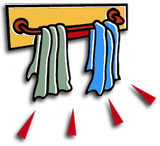 Cialdini's group found that by changing the wording of each sign slightly to add, "The majority of hotel guests reuse their towels," the level of compliance increased by 32%. Just this subtle indicator of "social proof" was enough to influence behavior significantly. Cialdini's group found that by changing the wording of each sign slightly to add, "The majority of hotel guests reuse their towels," the level of compliance increased by 32%. Just this subtle indicator of "social proof" was enough to influence behavior significantly.
Furthermore, when each room sign was reworded again to say that the majority of guests who stayed in that particular room reused their towels, the compliance jumped by a whopping 54%!
Such is the power of identifying with "similar people" -- even if those people are personally unknown to us other than by the fact that they supposedly stayed in the same room!
Example 2: Tax Cheaters, Latecomers, Nature Trail Visitors
One of the areas in which following the crowd can have unintended consequences takes place in any situation in which noncompliance is already occurring. When attempting to persuade people at large to stop doing something (e.g., stop cheating on their taxes, stop coming in late to work, stop picking up protected items along nature trails), the wording of the request is particularly tricky, says Cialdini.
Beware of saying or implying anything like this: "Because so many of you are doing this bad thing, we need to [impose a penalty, change the rules, or otherwise ask you to stop...]" This wording inadvertently communicates to people, "Everyone else is doing this undesirable thing, so it's OK for you to do it, too!"
 The research demonstrated that in each case where a request contained even a hint that many other people had been failing to comply, very little cooperation with the request occurred. The research demonstrated that in each case where a request contained even a hint that many other people had been failing to comply, very little cooperation with the request occurred.
Sometimes, even more non-cooperation occurred after the request was made! The trick, Cialdini says, is not to embed into the message any "social proof" of the bad thing that many people have been doing.
Rather, he recommends phrasing the message as,
"If even one person does this undesirable thing, it undermines the fairness of the system that serves us all. So please don't do it." This wording reveals nothing about who else is not complying, while still requesting the desired behavior.
In conclusion, to master the art and science of "responsible persuasion" that can influence people for their own good as well as for the good of society, be sure to devour all of the information in "Yes!"
Copyright 2010 Adele Sommers
|





 Today, I'm continuing the discussion of behavior and the fascinating research on influence. You might recall from prior newsletters that Dr. Robert Cialdini has published many groundbreaking findings on this subject over the past few decades.