Tips for Meeting Yourself in the Middle
with
Your Project Scheduling
by Adele Sommers
Must scheduling a project be a complex conundrum? Certainly, there's a science to the process and a method to the madness, particularly for large projects. But for smaller projects, it needn't be a scary exercise that requires sophisticated software.
Planning a project schedule can involve a fun, down-to-earth, low-tech approach that anyone can do. You start by identifying activities and milestones that your project will require. Then you put the activities and milestones into some kind of sequence.
This article describes a group-oriented technique to generate a basic idea of your schedule requirements. By working with simple materials, you and your team can roll up your sleeves and create a "timeline mural" that shows where your project activities and milestones will occur. And by creating this timeline both backwards and forwards, you'll be "meeting yourselves in the middle" with a realistic plan.
A Few Definitions Before We Get Started...
 Activities are components of work performed during the project to produce and deliver the products, services, or results. These activities might occur in a serial fashion, but more than likely, some will overlap and run in parallel. Activities are components of work performed during the project to produce and deliver the products, services, or results. These activities might occur in a serial fashion, but more than likely, some will overlap and run in parallel.
Activities are typically derived from a work breakdown structure (WBS). The WBS can organize and define the scope of a project by subdividing the project deliverables and work into smaller, more manageable chunks. Even if you don't have a WBS, you can brainstorm the activities that should occur using the exercises below!
Milestones have no time duration themselves, but they symbolically synchronize the events on the project. Milestones can serve as gates to ensure that all of the required activities occur before moving to the next stage. Milestones that you might want to recognize on the schedule include contractual dates, events, meetings, reviews, the completion of deliverables or subcomponents of deliverables, decision points, vendor deliveries, approval dates, project deliveries, and so on.
Planning a Schedule with Activities, Milestones, and Dates
This is a fun exercise to get everyone's input on scheduling!
 Step 1: Brainstorm activities and milestones Step 1: Brainstorm activities and milestones
Instructions: Involve the team, management, and anyone else participating in the planning process. Tape a big piece of butcher paper (or flip chart sheets) to the wall.
1) Brainstorm individually or as a group: a) the activities to be performed, and
b) the related milestones. (You could do this in two or more passes, if desired).
2) Record these ideas on sticky notes using two different colors, one for activities and the other for milestones, and place them randomly on the paper.

Step 2: Sequence the activities
Instructions: As a group, gather around the sticky-note collection and:
1) Begin to place the activities in some kind of logical sequence. In the first pass, you could do this quickly and silently, or discuss the process as you go. Keep looking for and filling in any gaps in the activity sequence.
2) In subsequent passes, you can move the activities into more specific workflows, some of which will logically run in parallel with others. For example, parallel activities are appearing below in the example of preparing for a trade show.
3) Determine where the activity dependencies exist in the workflows, also depicted in the example below. (A dependency is a logical relationship between two or more activities, where one activity must start or finish before another activity can start or finish.) In this example, some activities must complete before others can begin.
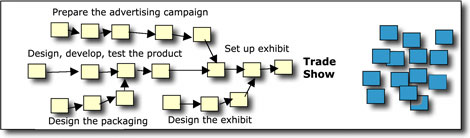
Step 3: Add milestones and fine-tune the sequence
Instructions: As a group, continue working with the sticky-note collection, and:
1) Begin to place milestones in appropriate places, refining the flow as needed. The milestones in the example below might include internal review meetings and trade show application deadlines, for instance.
2) In subsequent passes, begin identifying all fixed and flexible milestone dates. For example, a trade show has a fixed date from which you would work backward. Defining the project's duration should consider historical data, task estimates, and expert opinion; and potentially build in contingency buffers at strategic points to help mitigate lead-time risks (the subject of a more advanced analysis and discussion).
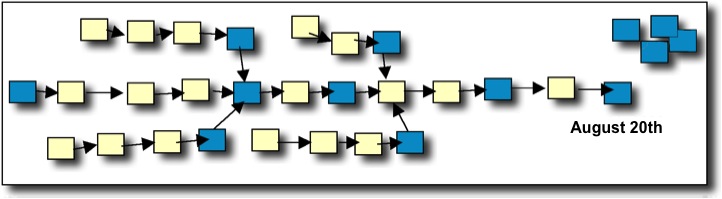
Step 4: Consider the schedule both backwards and forwards
Note that assigning milestone dates in the exercise above might occur because you are doing forward scheduling -- which will give you some idea of how soon you can start various activities.
In contrast, backward scheduling determines the latest time that you must start activities to avoid pushing out the completion date.
With regard to backward scheduling, events such as trade shows are good examples of fixed points that require reverse preparation. As shown in the prior examples, a show could be the strategic venue for a new product unveiling, a customer feedback occasion, or a new marketing campaign.

In conclusion, this simple, hands-on exercise can help project teams look at forward and backward scheduling like two oncoming trains. At some point, an open-ended, forward schedule needs to brake and begin readying for the train speeding in from the opposite direction!
Copyright 2010 Adele Sommers
|





 At this time of year, I find myself experiencing a nostalgic sensation of going back -- to school, to new projects or challenges, or to some as yet undefined, but mysteriously important destiny.

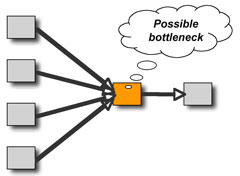 For instance, you could focus all attention on supplying resources to the bottleneck. You could possibly accelerate the flow of the work by relieving some performers of time-consuming tasks. Consider whether some jobs that generalists perform could occur in "assembly line mode," where specialists step in to handle certain things.