Resources and Techniques for Conquering Limitations
by Adele Sommers
The Theory of Constraints, introduced by Dr. Eli Goldratt over 20 years ago, has revolutionized U.S. and international business through its highly flexible and practical principles. The basic premise of TOC involves identifying and managing constraints, limitations, and bottlenecks in business and other situations to boost throughput, clarify tradeoffs, optimize choices, and increase profitability.
 Instead of simply lecturing people on how to use TOC, Goldratt uses fictional storytelling to explain the principles in riveting and memorable detail. The fascinating plots of his business novels enable people to assimilate a range of insights and applications through an engaging discovery process. Instead of simply lecturing people on how to use TOC, Goldratt uses fictional storytelling to explain the principles in riveting and memorable detail. The fascinating plots of his business novels enable people to assimilate a range of insights and applications through an engaging discovery process.
This article highlights four of Goldratt's novels and also provides a practical technique for removing limitations and constraints in your own business planning.
Goldratt's Novels Explore Many TOC Applications
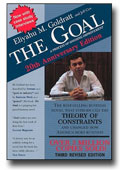 "The Goal," Goldratt's inaugural business novel two decades ago, focuses on the dilemmas and challenges that Alex Rogo, a new plant manager, faces in a serious business predicament. "The Goal," Goldratt's inaugural business novel two decades ago, focuses on the dilemmas and challenges that Alex Rogo, a new plant manager, faces in a serious business predicament.
Since his plant can't seem to ship any of its products on time, Alex learns that the business will go under unless he figures out what to do. He turns to Jonah, a consultant friend of his, whose theories and advice finally help Alex and his colleagues discover the brilliant TOC principles that break through the impasse.
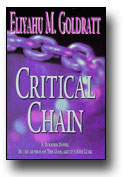 "Critical Chain" next explores TOC in the realm of project management. A business professor and a class of project managers hypothesize, debate, and ultimately realize why their projects often run late and over budget, or fail to complete everything that was originally specified. "Critical Chain" next explores TOC in the realm of project management. A business professor and a class of project managers hypothesize, debate, and ultimately realize why their projects often run late and over budget, or fail to complete everything that was originally specified.
As the protagonists examine a range of thorny project issues, we vicariously learn how to optimize a project's "critical path," handle resource conflicts, introduce safety buffers, negotiate with subcontractors and suppliers, and predict the effects of early vs. late starts. The resulting formula offers us several powerful ways to resolve these age-old project challenges.
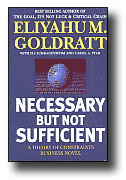 "Necessary But Not Sufficient" describes in cliff-hanging detail a range of difficulties that result from excess complexity in software products. The members of a highly competent and savvy development team cannot understand why they can no longer properly manage and test their enormous, feature-rich programs that are rapidly growing out of control. "Necessary But Not Sufficient" describes in cliff-hanging detail a range of difficulties that result from excess complexity in software products. The members of a highly competent and savvy development team cannot understand why they can no longer properly manage and test their enormous, feature-rich programs that are rapidly growing out of control.
The book studies the problems, pressures, and challenges of maintaining large, sophisticated systems -- especially those that continue to bloat because customers request more and more features. We learn that feature creep can ultimately become a lose-lose proposition unless developers introduce proactive measures to manage their system's constraints.
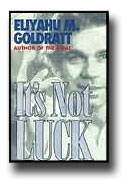 "It's Not Luck" applies the TOC principles in other interesting ways. Alex Rogo from "The Goal" returns, trying desperately to salvage another precarious situation in which four subsidiaries of his parent company are losing profitability and are about to be sold off. "It's Not Luck" applies the TOC principles in other interesting ways. Alex Rogo from "The Goal" returns, trying desperately to salvage another precarious situation in which four subsidiaries of his parent company are losing profitability and are about to be sold off.
Rogo's team painstakingly attempts to identify constraints in the marketplace, and ultimately stumbles upon ways to make irresistible offers to customers in a valiant effort to return the businesses to profitability. In the process, we, too, discover uses of TOC in marketing, inventory control, and production distribution.
This book also introduces Goldratt's Thinking Processes, a methodology for problem-solving, clarifying issues, and identifying and removing obstacles. Below is a simplified version that you can easily apply yourself!
A Step-by-Step, "TOC" Approach for Removing Constraints
When the magnitude of either a "grand vision" or smaller-scale undertaking seems overwhelming, it's quite possible to allow procrastination and obstacles -- real or perceived -- to block progress. To forge past this dilemma, use the six steps below to identify:
- A set of more detailed goals for the phases you've identified
- A set of obstacles that might prevent you from achieving those goals
- A set of intermediate objectives that would resolve each obstacle
- The prioritized order in which to proceed
- Ways to measure the results
- A set of action steps to take
Step 1. Make a list of goals you intend to achieve.
What is the purpose of each phase, and what do you expect to accomplish? What goals would help you fulfill them? You can create separate lists of goals for each phase, as desired.
Our Phase 1 purpose is to: |
Goals that will lead us to fulfill Phase 1 are: |
| |
1. |
| 2. |
| 3. |
Step 2. Identify obstacles that appear to block your goals.
Brainstorm with "sticky notes" all of the reasons why you cannot fulfill your goal(s). Be candid with what you perceive to be an obstacle. State each one in the present tense, in terms of what actually exists, rather than as a future possibility.
Obstacles to Phase 1 Goals
Examples:
a) The project depends on our securing a permit that we don’t have.
b) We don’t have the right team to do the work. |
| 1. |
| 2. |
| 3. |
Step 3. List a set of intermediate objectives that can eliminate each obstacle.
These types of objectives should state a way to either eliminate an obstacle or work around it. Each objective should be feasible. State each in the present tense, as if it were in place today. Brainstorm as many objectives as possible for each obstacle, then select the best option.
Obstacles
Example: The project depends on our securing a permit that we don’t have. |
Intermediate Objectives
Examples of solutions to the obstacle:
a) We implement a different method that doesn't need a permit.
b) We obtain the permit. |
1. |
1.
2.
3. |
2. |
1.
2.
3. |
Step 4. Sequence the intermediate objectives by feasibility or priority.
Analyze the list of intermediate objectives, and figure out how to put them in the proper sequence. Which ones should come first, second, and third? If you see that some objectives are building blocks for others, determine the order in which to proceed.
Hint: Before creating a list or table, first use sticky notes to spatially arrange the objectives on paper. Place the objectives that should occur first at the bottom of the paper, and move up the paper with objectives that address later obstacles. Draw arrows between them to show which objectives depend on which others occurring first. When you've finished this diagram, complete the table below.
List of Intermediate Objectives |
Sequence |
1. |
|
2. |
|
3. |
|
Step 5. Determine your evaluation criteria.
How will you know when your objectives have been achieved? How will you define success? Identify some kind of criteria that will verify whether you have succeeded.
List of Intermediate Objectives |
Sequence |
Evaluation Criteria |
1. |
|
|
2. |
|
|
3. |
|
|
Step 6. Take action to implement the prioritized objectives.
Each objective requires a set of actions to complete it. For example, to obtain a permit, you might need to 1) contact an agency, 2) fill out an application, and 3) send it in.
List of Intermediate Objectives |
Action Steps |
1. |
1.
2.
3.
|
2. |
1.
2.
3. |
In conclusion, Eli Goldratt's compelling novels explain how to use TOC and related "Thinking Processes" to manage constraints, remove obstacles, and achieve stellar results. By identifying implementation goals, actions, evaluation criteria, partners, and resources, you'll create a logical and feasible road map for success.
Copyright 2008 Adele Sommers
|





 Have you ever wondered whether any drag you've been experiencing occurs from insufficient knowledge, smarts, energy, talent, commitment, or resolve? These arenas represent aspects of our potential, but aren't necessarily what is holding us back.