Setting the Criteria and Conditions for Success
by Adele Sommers
Do you have a crystal clear idea of what kinds of business undertakings align with your gifts, talents, passions, and strengths? If so, you are in an excellent position to choose the prospects that can give you the greatest satisfaction and results.
 If not, this article explains how developing a set of "business success criteria" can help you select a worthwhile undertaking with much deeper insight, and thus establish conditions for successfully pursuing it. If not, this article explains how developing a set of "business success criteria" can help you select a worthwhile undertaking with much deeper insight, and thus establish conditions for successfully pursuing it.
Why is this crucial? Many people wander into businesses, projects, and professions opportunistically, meaning that they grab something that comes along because it's available and convenient. At times, this may be necessary for financial reasons. But unless we understand our underlying success criteria, we might not recognize the options that truly fuel and inspire us -- those best suited to our passions and strengths.
From "Corporate Passenger" to "Entrepreneurial Driver"
Identifying business success criteria can be easier for some people than for others. For example, those who leave corporate life to pursue an entrepreneurial endeavor may experience a more roundabout discovery process. For that reason, I'll use the following story to illustrate how this process might occur.
Roger and Roberta have grown tired of the grind and internal politics of corporate life. When their kids leave home, they conclude that it's time to switch to something more rewarding. But what? After a great deal of thought, they decide to start by contracting out their services to their former employers, which seems like the safest way to begin their transition. Later, they believe they will tackle some kind venture together, such as starting or buying a business.
After spending many years working as jobholders, however, their mindsets are still functioning in an employee mode. Because their outlooks revolve primarily around meeting the expectations of others, Roger and Roberta simply haven't developed their own sets of values, visions, and goals.
 In some ways, they feel as if they've been passengers in the back seat of a moving car, unable to steer. To pursue starting or buying their own business, they'll need to find a way to move from the "passenger's seat" to the "driver's seat" where they'll have better visibility and more control over their destinies. In some ways, they feel as if they've been passengers in the back seat of a moving car, unable to steer. To pursue starting or buying their own business, they'll need to find a way to move from the "passenger's seat" to the "driver's seat" where they'll have better visibility and more control over their destinies.
And although they don't realize it yet, doing this will mean changing their mindsets. They'll first need to shift from thinking like employees to thinking like contractors. Then they'll need to start thinking like consultants. Ultimately, they'll need to think like entrepreneurs.
Seeking Their Business Success Criteria
Roger's and Roberta's journey occurs in three stages as they gradually make the shift from one mindset to the next.
1) Making the transition from employee to contractor
As Roger and Roberta begin contracting their services to their former employers, they learn how to set up their own business identities, home offices, schedules, and accounting systems. Yet much like their prior employee days, they continue working with the same familiar people to meet the same unexceptional expectations.
Soon, the projects they're working on seem tedious and dissatisfying because of the highly predictable problems and shortcomings. Eventually, Roberta and Roger begin to question what they're really seeking from self-employment. They secretly yearn to climb off of the tiresome treadmills that characterize their current working mode.
2) Making the transition from contractor to consultant
After much discussion and introspection, Roberta and Roger recognize that they have not yet developed an independent perspective on their professions. They see that everything they've done thus far satisfies someone else's conventions rather than their own.
 Today, however, they're operating in a self-governing mode. They have no need to view themselves as quasi-employees if they choose to see themselves differently. Today, however, they're operating in a self-governing mode. They have no need to view themselves as quasi-employees if they choose to see themselves differently.
It begins to dawn on Roberta and Roger that their former employers are currently their clients, and they are consultants (guides and advisers), in addition to being contractors. This means they have a right -- and a need -- to set their own policies and develop procedures and best practices for their service businesses. Whenever their assigned projects backfire with predictable problems, they don't need to quietly defer to the people making mistakes. They can make proactive recommendations.
Roberta and Roger also see that they can look for new clients whose outlooks and approaches align with their own. When they better qualify their clients, they'll have more satisfying working relationships and outcomes. They are no longer feeling the need to accept clients on a financial basis only; nothing seems worth the hassle and stress of bad relationships and projects. This realization represents their first major step toward establishing their own business success criteria.
3) Making the transition from consultant to entrepreneur
Roger and Roberta are happier, but still unclear about what represents an ideal scenario and how they would know it if they saw it. They resolve to undertake a methodical, soul-searching process to better align their business goals with their mission in life.
 During this process, they meticulously identify their passions, purpose, strengths, gifts, life themes, and core values. By the end, they have a list of specific ways in which they can judge future business ventures, partners, clients, and projects. Some of the criteria are more practical and others more lofty. But each selected criterion seems crucial to achieving balance, fulfillment, and higher contribution in their lives. During this process, they meticulously identify their passions, purpose, strengths, gifts, life themes, and core values. By the end, they have a list of specific ways in which they can judge future business ventures, partners, clients, and projects. Some of the criteria are more practical and others more lofty. But each selected criterion seems crucial to achieving balance, fulfillment, and higher contribution in their lives.
For example, their criteria include everything from maintaining a healthy mix of work and recreation to seeking only what they believe they could be the best in the world at doing. Roger and Roberta then assign numerical weights to their criteria. In this way, they create a powerful checklist for comparing, scoring, evaluating, and then selecting future business ventures, which will thereby set the conditions for success.
In conclusion, aligning our life passions with our business purpose helps us define our business success criteria. When we shift into an entrepreneurial mode, especially after many years of corporate employment, these criteria illuminate how to choose the right situations, and establish the conditions for successfully pursuing them.
Copyright 2006 Adele Sommers
|





 Have you seen the 90-minute Web video called "

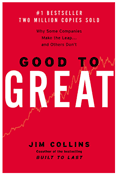 This thought-provoking reflection is one of many from Jim Collins' excellent book, "