|
|
December 2012
Volume 8, Issue 12
These are monthly tips on boosting
business and professional results.
Start your subscription!
To change subscription options, please
see the bottom of the page.
 Like us on Facebook! Like us on Facebook!
|
|
Happy New Year!
Below find this month’s newsletter, hot off the press!
- Feature Article: Go Beyond Brainstorming
with a Breakthrough Follow-up Technique
Please add “Adele@LearnShareProsper.com” to your whitelist or address book in your e-mail program,
so that you have no trouble receiving future issues.
You subscribed to this newsletter at LearnShareProsper.com. You’re very welcome to forward it to your
colleagues; please just keep the entire message intact.
If you wish to discontinue your subscription, please
use the links at the bottom. |
|
 |
|
Turbocharge Your Meeting Results
 Last month, we delved into the power of meeting agendas and summaries to turn time-wasting, profit-stealing meeting chaos into profit-boosting outcomes. Last month, we delved into the power of meeting agendas and summaries to turn time-wasting, profit-stealing meeting chaos into profit-boosting outcomes.
To build on those ideas, we’ll next explore a systematic approach to brainstorming that will enable your meetings to produce more and better results than you ever imagined.
Effective brainstorming is not always an intuitive process, as evidenced by the many folks who really struggle with using it meaningfully. It usually begins with a classic process that you might be very familiar with. But how it ends can, in many cases, make all of the difference in the world.
That’s why today’s newsletter focuses on both the start of the process and a very powerful follow-up technique that works especially well for challenges that defy typical discussion protocols. It may not be necessary for many routine matters, but when it’s needed, it works like a charm!
So, I hope you enjoy this month’s features, and as always, please be sure to join the ongoing conversations by leaving your comments on my Facebook page!
Here’s to your business prosperity,

Adele Sommers, Ph.D., business improvement specialist, author, educator, and award-winning instructional designer
P.S. If you missed any previous issue, please visit
the newsletter archive! |
|

|
|
Tips on Using the Classic Brainstorming Model
Timeless, tried-and-true brainstorming techniques are among the well-known tools that people use globally to generate new ideas. The techniques below offer a flexible framework on which to build many types of creative solutions. Try using the steps listed and then continue to the “Feature Article” for more ideas. Good luck!
- Set a time limit for brainstorming, such as 30 minutes or more.
- State the purpose of the session. Try to use neutral wording to inspire a full spectrum of possible contributions.
- Establish guidelines that encourage everyone to participate, regardless of their role or rank. For example, if you initially go around the room to collect ideas from each person, you will ensure that everyone makes at least one contribution.
 Urge people to be creative and strive to generate unusual, far out, wild, and even “crazy” ideas. Urge people to be creative and strive to generate unusual, far out, wild, and even “crazy” ideas.
- When capturing inputs, a short sentence is best for clarity. Avoid using only one or two words or, in contrast, an entire paragraph.
- As people offer their thoughts, record them on a flipchart or via an electronic projection system so the whole group can easily see them. Alternatively, people can record their own ideas on sticky notes or cards and post them on the wall.
- A related technique involves “priming the pump” by having the participants spend 10–15 minutes silently creating their own lists. They can then read the ideas aloud, one idea at a time, by going around the room. In this case, several rounds may be needed to expand on previously contributed ideas.
- Aim to generate as many ideas as possible, building on the inputs of others.
- (This is important!) As part of the ground rules, do not let people criticize, discuss, filter, or judge ideas as others are voicing them. And urge everyone to avoid negative noises and facial expressions, such as sighing, muttering, smirking, frowning, or rolling their eyes when others are talking.
- After the brainstorming is over, you can use a variety of techniques to work with the inputs (see the “Feature Article” below).
|
|
 |
Go Beyond Brainstorming
with a
Breakthrough Follow-up Technique
by Adele Sommers
How do you get people to generate truly extraordinary ideas? When you need to summon people’s imaginations to design a system, bring new insights to a thorny problem, conjure up themes for a new campaign, or revitalize a lackluster program, what would you and your team do? You’d usually brainstorm, right?
Sure! But what I have in mind is a kind of brainstorming process that will not only produce highly imaginative thinking, it will also involve little or no discussion of the ideas themselves until the very end.
Does that sound impossible? How can people brainstorm successfully from start to finish without actually hashing out each and every idea?
Here’s how: The process begins with classic brainstorming (for a refresher, see the “Special Message” section above). It then proceeds to a silent follow-up technique that produces fresh ideas as well as blends dissimilar inputs into a cohesive whole.
Especially if the purpose is to explore a complex, unfamiliar, or fuzzy problem that requires novel thinking, using this method can yield unexpectedly creative and powerful results. One reason why it works so well is that it uses a highly inclusive approach to working with divergent contributions, which doesn’t discard any ideas.
Ready to try it? Okay, let’s go!
Part 1: Silently begin grouping the ideas.
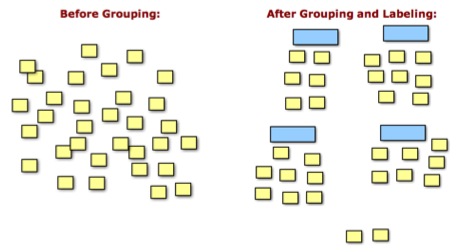
After conducting a classic brainstorming session per the guidelines above, do the following to quietly group the ideas into what is known as an “Affinity Diagram.”
Be sure that the ideas are recorded on physical note cards or sticky notes for the procedure below, which may require 30 minutes or more to complete. Remember that there should be no talking, commenting, whispering, or thinking out loud!
 |
Display the idea cards or notes in a random arrangement. Whether you’re placing the idea notes on a wall or on a flat surface, just be sure that they are as mixed up as possible. |
|
Mobilize the entire team. Have all participants position themselves around the idea display area. Be sure that everyone takes part, but without any discussion or talking to oneself. |
|
Begin silently moving ideas around. Have people scan the ideas and freely place individual cards near any other cards that seem to “relate.” (This is what is meant by the term “affinity” in the “Affinity Diagram.”) Note that there are no “logical” criteria for arranging cards this way. Deciding which ideas relate to each other can occur based on gut-level instinct rather than logic.
In fact, the less thinking involved, the better! That’s why very quick reactions work best. You’re seeking brand new thought patterns. Those usually don’t arise unless you use a different part of the brain. |
|
Continue moving ideas around until they’re all grouped.
Don’t succumb to the temptation of letting someone in authority categorize them in a hierarchy or in some other obvious pattern.
If someone moves an idea away from the spot where you’ve placed it, don’t argue — but do be undiplomatic by simply moving it back, if you feel that it belonged where it was. Note, however, that all of the other participants have the same option! That way, no one can “pull rank” in this exercise.
Keep the process going until all ideas have found homes in groups of 6–10, and everyone feels satisfied with where they have landed. (Note that satisfaction will come more from the idea arrangement “feeling right” than it will from “making sense.”) Sometimes there will be a few stray cards left over that might not fit anywhere. |
Part 2: Create headings for the grouped ideas.
Whew! The most challenging part — the silent idea grouping — is complete, and it is time to talk. However, you aren’t going to discuss the individual ideas. You’re simply going to agree on the headings that best summarize each idea grouping in your Affinity Diagram.
|
Select a descriptive phrase for each grouping. Sometimes an existing card will adequately describe the theme of its entire group; it can then become the heading.
When there is no such card, have the participants suggest a short, expressive phrase that clearly communicates what that grouping represents.
Place a card or sticky note containing the heading label above each grouping. When two or more groups relate to one another, you can create a “super-header label” for them. |
|
Evaluate the heading labels for clarity and quality. Can those labels convey the meaning of each grouping to someone who didn’t take part in the exercise? Be sure each heading phrase contains a clear descriptor rather than fuzzy or jargon-filled wording. |
Part 3: Decide what should happen next.
So, what do you do with these idea groupings? The answer depends on the nature of the problem and where the team landed with the exercise.
The Affinity Diagram alone might be enough to stimulate an all-new approach to the issue, where each grouping might represent its own action strategy. Or, it could be the first of several stages of exploring the ideas in more depth. If you decide to continue the process, here are some possible next steps:
|
Continue with other participants. Especially if the issue affects others, such as fellow team members, functions, or departments, you can engage them in a continuation of this exercise. Carefully roll up and transport the diagram to an accessible location where the others can visit it. It might reside in a hallway, a break room, or cafeteria, for example.
If it’s possible to leave the diagram there for a while, such as a week or longer, you and your colleagues can continue to add ideas, move the ideas around, and continue regrouping them until either the time runs out or the activity simply winds down. |
|
Continue with other tools. Whether or not you have continued the grouping exercise, you and your team might wish to explore various other angles related to the issue at hand. For example, you might want to look for cause-and-effect relationships or create a prioritized plan of action.
For more information on continuation tools you can use, refer to the Memory JoggerTM II, from http://www.goalqpc.com. |
In conclusion, the power of this exercise lies in its ability to preserve all ideas and let them influence the big picture from unique and unpredictable viewpoints. Many teams find this to be a potent and refreshing way to honor the creative spirit of all members. Absent are quibbles over semantics and any filtering mechanisms, which can result in discarding potential solutions.
So, by combining classic brainstorming techniques with a silent grouping and labeling process, your team can manifest creative ideas that lead to breakthrough resolutions!
Copyright 2012 Adele Sommers |
|
 |
|
The “Meeting Success Kit”
 Would
you like to transform your meetings from “profit stealers” to “profit boosters”? Why not make it your goal to eliminate those dysfunctional meetings, once and for all — even if you're not the person running
them! Would
you like to transform your meetings from “profit stealers” to “profit boosters”? Why not make it your goal to eliminate those dysfunctional meetings, once and for all — even if you're not the person running
them!
You can do it with my “how-to”
tools for making meetings hum and participants sing on key. No more
sharps or flats to worry about with my Meeting
Success Kit by your side.
This expanded
edition delivers seven powerful step-by-step checklists;
“guerrilla techniques” for diplomatically handling meeting challenges from the sidelines; in-depth case studies that can help you erase meeting
headaches forever; and 62 minutes of MP3 audio with a full transcript. |
|
 |
|
Adele Sommers, Ph.D. is the author of “Straight
Talk on Boosting Business Performance” — an award-winning
Special Report and Workbook program.
If you liked today’s issue, you’ll love this down-to-earth
overview of how 12 potent business-boosting strategies
can reenergize the morale and productivity of your enterprise,
tame unruly projects, and attract loyal, satisfied customers.
It’s accompanied by a step-by-step workbook designed
to help you easily create your own success action plan.
Browse the table of contents and reader reviews on the
description page.
Adele also offers no-cost articles and resources to
help small businesses and large organizations accelerate
productivity and increase profitability. Learn more
at LearnShareProsper.com.
LearnShareProsper.com/Business Performance_Inc.,
7343 El Camino Real, Suite 125, Atascadero, CA 93422,
USA. For information and Customer Service, call +1-805-462-2187,
or e-mail Info@LearnShareProsper.com. |
|
|
|
| |
|
©2012
Business Performance_Inc., Adele Sommers, All rights
reserved. www.LearnShareProsper.com
Your feedback is always appreciated!
Write to us at info@LearnShareProsper.com.
We respect your privacy and do not give out or sell
subscriber names or e-mail addresses.
Please use the links below to take
yourself off our list or change your e-mail address.
|
|
|