|
A Simple Risk Management Process
by Adele Sommers
Getting a handle on
project risks is a slippery job, but well worth
the effort if you and your project team desire to sleep
more soundly at night. In Part
2 of this series, we identified various risks related
to choosing, estimating, and staffing your projects.
In Part
3, we assessed the potential adverse effects of
those risks on the project cost, schedule, quality,
and features.
Following assessment,
the mitigation phase involves brainstorming
ways to avoid, eliminate, work around, or otherwise
manage each identified risk. This article (Part 4 of
the series) takes you through a simple, four-step
risk management process. The results can help you
and your team decide whether or not to take on a project,
and can aid in pinpointing the most effective risk management
techniques to use.
Risk Assessment Review
In Part 3, we discussed
an example in which your family has approached you 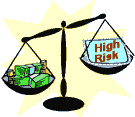 about
redecorating your kitchen because your relatives are
coming for a family reunion the week after next. Your
family has many items on its “wish list” (new
paint treatment, resurfacing the cabinetry, laying new
tile, and installing new crown molding). All of this
must be completed in the next two weekends, which gives
you only four days! about
redecorating your kitchen because your relatives are
coming for a family reunion the week after next. Your
family has many items on its “wish list” (new
paint treatment, resurfacing the cabinetry, laying new
tile, and installing new crown molding). All of this
must be completed in the next two weekends, which gives
you only four days!
Since you don’t
believe you have nearly enough time to complete the
project, during your risk assessment, you labeled one
of the risks “Too Many Features/Too Little Time.”
This means the project requirements are too numerous,
too complex, or both, given the time available. This
risk also scored high in terms of its potential negative
impact on cost, schedule, quality, and features.
Mitigating the Risks
You’ve Assessed — Can You Do It Successfully?
Once you have a list
of assessed risks, you can begin brainstorming a variety
of ways to avoid, minimize, or manage them. This is
a quick and simple process for doing so.
1. Consider whether
you can completely avoid or eliminate each risk.
If your risk involves
not having enough time to incorporate certain requested
features, is it possible to agree on removing the features
from the requirements list entirely? Record any ideas
for avoiding the risk altogether.
Example. With
the kitchen redecorating job, you might consider these
options:
- Radically reduce the number of features; for example,
only paint the walls.
- Push out the schedule significantly. Maybe the relatives
can come next year.
2. If you can't avoid
a risk, brainstorm risk management alternatives.
 Alternatives
are ways of mitigating the risk — from the simplest
ideas to more sophisticated solutions. For the Features-versus-Time
risk, one strategy could be to negotiate a way to
phase in the features over time. Another might entail
engaging more people or resources to address the features,
if feasible. In some situations, you might even be able
to buy insurance to mitigate a risk. Alternatives
are ways of mitigating the risk — from the simplest
ideas to more sophisticated solutions. For the Features-versus-Time
risk, one strategy could be to negotiate a way to
phase in the features over time. Another might entail
engaging more people or resources to address the features,
if feasible. In some situations, you might even be able
to buy insurance to mitigate a risk.
Example. With
the kitchen redecorating job, you could:
- Hire professionals to do the work, if there are
any available on short notice.
- Recruit semi-experienced friends or neighbors to
help for the next 10 days.
- Use faster, simpler techniques and materials (such
as stick-on vinyl tiles).
- Plan to have a second kitchen set up in the backyard
BBQ area, just in case.
3. Identify your “do-nothing”
and “next-to-nothing” alternatives.
 These
are the options that would remain available to you if
you did not pursue the project or solution you're considering.
“Do-nothing” could mean the status quo, for
example, and “Next-to-nothing” might denote
an option that already exists but has been ignored.
These will help you remain clear about whether you must
do something, and what your fallback position is if
you can’t do anything. These
are the options that would remain available to you if
you did not pursue the project or solution you're considering.
“Do-nothing” could mean the status quo, for
example, and “Next-to-nothing” might denote
an option that already exists but has been ignored.
These will help you remain clear about whether you must
do something, and what your fallback position is if
you can’t do anything.
Example. Instead
of the kitchen redecorating job, why not:
- Hold the family reunion somewhere else, such as
in a hotel in another city.
- Forget what the relatives think. Don’t worry
about the kitchen because everyone will be too busy
visiting to notice!
4. Give each risk
alternative a “risk reduction likelihood”
score or rating.
If you want to move forward
with the project or solution, but can’t find a
way to avoid or eliminate the risk, you can weigh the
relative merits of each alternative you brainstormed
in #2 above.
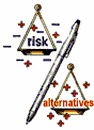 Similar
to the Assessment Phase, you can assign relevant values
to each of your alternatives. In this case, these values
represent the likelihood that each alternative can significantly
reduce the negative impact of the risk on the four key
factors: cost, schedule, quality, and features. Similar
to the Assessment Phase, you can assign relevant values
to each of your alternatives. In this case, these values
represent the likelihood that each alternative can significantly
reduce the negative impact of the risk on the four key
factors: cost, schedule, quality, and features.
For instance, a High
Likelihood of reducing the impact might be a
9, a Medium Likelihood a 5,
a Low Likelihood a 1, and No
Likelihood a zero, with a different value
possible for each of the four key areas.
By adding up the values
for each alternative, you'll have a rough score for
each that indicates which alternatives seem to be the
best candidates for minimizing the risk — the
higher the score, the better. You also might consider
whether to combine alternatives. Using two or more together
might help reduce the risk in a complementary way.
Example: Your
family wishes to move ahead with the project with all
of the current requirements. After scoring and comparing
the alternatives, it appears that seeking professionals
to do the work might best minimize the risk. If that’s
not possible, your family will do the work with simpler
materials and methods and extensive help from friends.
Either way, you can always set up a second kitchen as
a contingency plan.
What’s the Plan?
When you're finished,
you’ll have a risk management plan consisting of
analyzed risks with a ranked list of alternatives for
handling each one. And even if you decide not to take
on the project you are evaluating, you will have used
20:20 foresight to make that decision instead
of the 20:20 hindsight that’s usually required
to find out the hard way — after the fact!
Copyright 2005
Adele Sommers
|





 December
offers an ideal time to reflect on all that we've
achieved during the year, as well as what we intend
to do in the months ahead. It's also a chance to ask
ourselves, “Have I followed through on my promises
to myself and others?”
December
offers an ideal time to reflect on all that we've
achieved during the year, as well as what we intend
to do in the months ahead. It's also a chance to ask
ourselves, “Have I followed through on my promises
to myself and others?” 

 A
multiple-question format typically collects demographic
data (such as addresses, age brackets,
or how many pets people own). It's also used to collect
opinions, such as in satisfaction polls or course evaluations.
A
multiple-question format typically collects demographic
data (such as addresses, age brackets,
or how many pets people own). It's also used to collect
opinions, such as in satisfaction polls or course evaluations.


 “
“